PECTAA 3-Day AI Training for 680 Master Trainers Under the TALEEM Project: Complete Schedule, District Quota, and Pedagogical Guide
Introduction
Public education in Punjab is entering a recent phase of digital instructional design. Through official directive PECTAA/Director(T&C)/2026-40, issued on 14th October 2026 from Link Wahdat Road, Lahore, the Punjab Education Curriculum Training and Assessment Authority (PECTAA) announced a 3-Day Training Programme on Artificial Intelligence (AI) for 680 Master Trainers (MTs) across the province. Addressed to all Chief Executive Officers (CEOs) of District Education Authorities (DEAs) and Heads of District PECTAAs, this initiative runs under the TALEEM Project in two consecutive batches from 26th October to 31st October 2026.
Building on recent Punjab School Education Department initiatives that established PECTAA as the central body for curriculum and assessment reform, this program transitions general sector teachers from passive consumers of technology to active practitioners of classroom AI. The 680 nominated Lead Trainers will complete intensive, hands-on training at designated Divisional PECTAA Head Offices before leading a province-wide cascade for primary-level AI-Focal Persons across all 40 districts of Punjab.
Official Training Schedule and Batch Structure
PECTAA has structured the 3-day capacity-building workshop into two equal cohorts of 340 participants each. Conducting the sessions at designated Divisional PECTAA Head Offices keeps cohort sizes manageable for interactive laboratory exercises and genuine-time supervision.
| Batch Number | Training Dates | Duration | Nominated Master Trainers | Training Venue |
|---|---|---|---|---|
| Batch-I | 26-10-2026 to 28-10-2026 | 3 Days | 340 Participants | Designated Divisional PECTAA Head Offices |
| Batch-II | 29-10-2026 to 31-10-2026 | 3 Days | 340 Participants | Designated Divisional PECTAA Head Offices |
| Grand Total | 26-10-2026 to 31-10-2026 | 6 Days Total | 680 Participants | All 10 Divisions of Punjab |
Division and District-Wise Allocation Plan (Annexure-A)
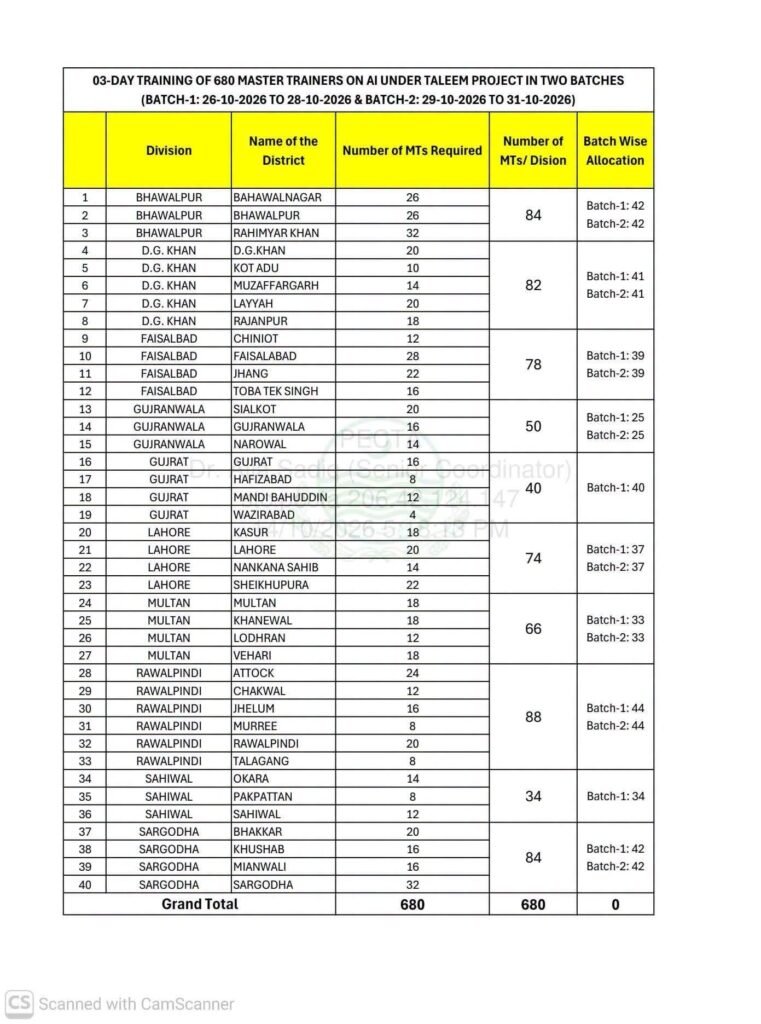
To guarantee balanced representation across urban, peri-urban, and rural schooling clusters, Annexure-A of the official notification assigns precise Master Trainer quotas to all 10 administrative divisions and 40 districts of Punjab.
Regional Distribution Strategy
While eight divisions split their nominated Master Trainers evenly across Batch-I and Batch-II, two divisions—Gujrat (40 MTs) and Sahiwal (34 MTs)—whole their entire training allocation during Batch-I (26th to 28th October 2026). Conversely, to maintain the exact 340-seat balance per cohort across the province, Rawalpindi leads all divisions with 88 nominated trainers, followed closely by Bahawalpur (84), Sargodha (84), and D.G. Khan (82). This distribution follows the structured deployment model seen in earlier PECTAA 4-day educator training initiatives, ensuring high-want districts in South and West Punjab obtain robust instructional leadership.
Complete District-Wise Seat Allocation Table
| Sr. No. | Division | Name of the District | Number of MTs Required | Division Total | Batch-Wise Allocation |
|---|---|---|---|---|---|
| 1 | Bahawalpur | Bahawalnagar | 26 | 84 | Batch-1: 42, Batch-2: 42 |
| 2 | Bahawalpur | Bahawalpur | 26 | 84 | Batch-1: 42, Batch-2: 42 |
| 3 | Bahawalpur | Rahim Yar Khan | 32 | 84 | Batch-1: 42, Batch-2: 42 |
| 4 | D.G. Khan | D.G. Khan | 20 | 82 | Batch-1: 41, Batch-2: 41 |
| 5 | D.G. Khan | Kot Adu | 10 | 82 | Batch-1: 41, Batch-2: 41 |
| 6 | D.G. Khan | Muzaffargarh | 14 | 82 | Batch-1: 41, Batch-2: 41 |
| 7 | D.G. Khan | Layyah | 20 | 82 | Batch-1: 41, Batch-2: 41 |
| 8 | D.G. Khan | Rajanpur | 18 | 82 | Batch-1: 41, Batch-2: 41 |
| 9 | Faisalabad | Chiniot | 12 | 78 | Batch-1: 39, Batch-2: 39 |
| 10 | Faisalabad | Faisalabad | 28 | 78 | Batch-1: 39, Batch-2: 39 |
| 11 | Faisalabad | Jhang | 22 | 78 | Batch-1: 39, Batch-2: 39 |
| 12 | Faisalabad | Toba Tek Singh | 16 | 78 | Batch-1: 39, Batch-2: 39 |
| 13 | Gujranwala | Sialkot | 20 | 50 | Batch-1: 25, Batch-2: 25 |
| 14 | Gujranwala | Gujranwala | 16 | 50 | Batch-1: 25, Batch-2: 25 |
| 15 | Gujranwala | Narowal | 14 | 50 | Batch-1: 25, Batch-2: 25 |
| 16 | Gujrat | Gujrat | 16 | 40 | Batch-1: 40 |
| 17 | Gujrat | Hafizabad | 8 | 40 | Batch-1: 40 |
| 18 | Gujrat | Mandi Bahauddin | 12 | 40 | Batch-1: 40 |
| 19 | Gujrat | Wazirabad | 4 | 40 | Batch-1: 40 |
| 20 | Lahore | Kasur | 18 | 74 | Batch-1: 37, Batch-2: 37 |
| 21 | Lahore | Lahore | 20 | 74 | Batch-1: 37, Batch-2: 37 |
| 22 | Lahore | Nankana Sahib | 14 | 74 | Batch-1: 37, Batch-2: 37 |
| 23 | Lahore | Sheikhupura | 22 | 74 | Batch-1: 37, Batch-2: 37 |
| 24 | Multan | Multan | 18 | 66 | Batch-1: 33, Batch-2: 33 |
| 25 | Multan | Khanewal | 18 | 66 | Batch-1: 33, Batch-2: 33 |
| 26 | Multan | Lodhran | 12 | 66 | Batch-1: 33, Batch-2: 33 |
| 27 | Multan | Vehari | 18 | 66 | Batch-1: 33, Batch-2: 33 |
| 28 | Rawalpindi | Attock | 24 | 88 | Batch-1: 44, Batch-2: 44 |
| 29 | Rawalpindi | Chakwal | 12 | 88 | Batch-1: 44, Batch-2: 44 |
| 30 | Rawalpindi | Jhelum | 16 | 88 | Batch-1: 44, Batch-2: 44 |
| 31 | Rawalpindi | Murree | 8 | 88 | Batch-1: 44, Batch-2: 44 |
| 32 | Rawalpindi | Rawalpindi | 20 | 88 | Batch-1: 44, Batch-2: 44 |
| 33 | Rawalpindi | Talagang | 8 | 88 | Batch-1: 44, Batch-2: 44 |
| 34 | Sahiwal | Okara | 14 | 34 | Batch-1: 34 |
| 35 | Sahiwal | Pakpattan | 8 | 34 | Batch-1: 34 |
| 36 | Sahiwal | Sahiwal | 12 | 34 | Batch-1: 34 |
| 37 | Sargodha | Bhakkar | 20 | 84 | Batch-1: 42, Batch-2: 42 |
| 38 | Sargodha | Khushab | 16 | 84 | Batch-1: 42, Batch-2: 42 |
| 39 | Sargodha | Mianwali | 16 | 84 | Batch-1: 42, Batch-2: 42 |
| 40 | Sargodha | Sargodha | 32 | 84 | Batch-1: 42, Batch-2: 42 |
| Total | 10 Divisions | 40 Districts | 680 MTs | 680 MTs | Batch-1: 340, Batch-2: 340 |
Core Curriculum and Pedagogical Competencies
Paragraph 3 of the PECTAA notification outlines a comprehensive curriculum designed to develop both technical fluency and ethical judgment. The training aligns closely with global benchmarks in the UNESCO Guidance for Generative AI in Education and Research and systemic capacity-building principles promoted by the World Bank Digital Technologies in Education program.
1. Instructional Design and Classroom Productivity
- Automated Lesson Planning: Generating structured daily and weekly lesson plans mapped to Student Learning Outcomes (SLOs) and national curriculum standards.
- Localized Content Development: Drafting bilingual reading passages, low-cost science activities, and culturally relevant classroom examples for primary learners.
- Teacher Productivity Enhancement: Streamlining routine administrative documentation, scheme-of-task formatting, and classroom record management.
2. Diagnostic Assessment and Inclusive Learning
- Formative Assessment Design: Creating multiple-choice query banks, diagnostic quizzes, and grading rubrics tailored to distinct cognitive levels.
- Personalized Learning Pathways: Adapting instructional tasks for multi-grade classrooms so struggling readers and advanced learners get targeted support.
- Inclusive Education Support: Designing accessible learning aids and simplified explanations for children with diverse learning needs.
3. Ethical AI Governance and Critical Literacy
- Responsible AI Usage: Establishing clear boundaries between AI-assisted scaffolding and authentic human instruction in the classroom.
- Privacy and Data Protection: Safeguarding student identities and institutional records by not ever inputting confidential personal data into open AI models.
- Critical AI Literacy: Evaluating AI-generated responses for factual accuracy, cultural bias, and age appropriateness before introducing materials to students.
Mandatory Compliance Guidelines for Nominated Master Trainers
To ensure every workshop session functions as a productive practical laboratory, Section 4 of the directive enforces strict compliance protocols that mirror the preparation standards in PECTAA early childhood education training guidelines:
- Working Laptop and Charger: Bringing a fully functional personal laptop with its power adapter to participate in hands-on prompt engineering and information generation labs.
- Active Practical Engagement: Participating directly in group exercises, live utility demonstrations, micro-teaching simulations, and collaborative problem-solving tasks.
- Official Dress Code Compliance: Observing the formal departmental dress code prescribed for state educators throughout all three days of the workshop.
- Assessment Completion: Submitting all assigned learning portfolios, practical exercises, and post-module evaluations required for certification.
- Full-Duration Attendance: Remaining present for the entire three-day schedule while avoiding unauthorized absences or early departures.
Comparison: Traditional Teacher Training vs. PECTAA AI-Driven Training
Evaluating conventional professional development alongside PECTAA’s AI capacity-building model highlights how generative tools reshape day-to-day teaching workflows:
| Evaluation Metric | Traditional In-Service Teacher Training | PECTAA AI-Driven Master Trainer Program |
|---|---|---|
| Training Delivery Mode | Lecture-heavy theory and printed manual reviews | Hands-on laptop laboratories and live AI application workflows |
| Lesson Plan Preparation | Manual drafting requiring several hours per week | Rapid prompt-based scaffolding customized to exact SLOs |
| Classroom Differentiation | Uniform worksheets targeting a single competency standard | Multi-tiered exercises adapted for diverse pupil pacing |
| Assessment Creation | Static, repetitive tests copied from textbook exercises | Dynamic formative quizzes and instant analytical rubrics |
| Administrative Workload | High clerical burden reducing student interaction duration | Automated routine drafting freeing teachers for active mentoring |
| Risk Management | Minimal focus on digital safety or algorithmic bias | Dedicated modules on data privacy, AI safety, and critical literacy |
The TALEEM Project Cascade Implementation Model
Paragraph 5 of the notification establishes the long-term multiplier effect of this training: nominated Master Trainers will subsequently train designated AI-Focal Persons at the primary level. Rather than ending after six days in October, the divisional workshops serve as Phase 1 of a tiered provincial rollout:
- Phase 1 (Divisional Training): PECTAA trains 680 Master Trainers across 10 divisional headquarters in late October 2026.
- Phase 2 (District & Tehsil Cascade): Master Trainers return to their 40 respective districts to train primary-level AI-Focal Persons under the TALEEM Project.
- Phase 3 (Classroom Integration): Trained AI-Focal Persons mentor primary school teachers in applying AI for foundational literacy, numeracy, and lesson delivery.
Analysis
Reviewing notification PECTAA/Director(T&C)/2026-40 and its accompanying Annexure-A highlights four major strategic priorities for Punjab’s education sector:
- Focus on Primary-Level Foundations: Targeting the downstream cascade specifically at primary-stage AI-Focal Persons shows that PECTAA aims to strengthen foundational literacy and numeracy during early schooling years.
- Balanced Provincial Representation: Allocating substantial quotas to divisions like Bahawalpur (84 MTs), Sargodha (84 MTs), and D.G. Khan (82 MTs) ensures peripheral districts advance alongside major urban centers.
- Shift Toward Practical Tool Mastery: Requiring every participant to bring a working laptop with a charger signals a move away from passive seminars toward demonstrable technical execution.
- Early Integration of AI Safety: Including data protection, ethical usage, and critical AI literacy alongside productivity modules protects students and teachers from unverified outputs and privacy risks.
Opinion
Equipping 680 Master Trainers with practical AI skills under the TALEEM Project is one of the most forward-thinking pedagogical reforms introduced in Punjab’s open academy structure. For decades, public sector teachers have struggled with overcrowded classrooms, multi-grade instruction, and heavy clerical workloads that leave little room for individualized pupil attention. Used thoughtfully, AI acts as a practical teaching assistant—helping an educator in Rajanpur, Bhakkar, or Chakwal generate localized reading materials, differentiated math problems, and structured lesson plans in minutes.
Nonetheless, the long-term impact of this initiative depends on what happens after the divisional workshops conclude on 31st October 2026. A three-day intensive bootcamp can construct foundational awareness and excitement, yet translating that momentum to primary schools requires reliable internet connectivity, access to no-cost or department-supported AI tools, and Urdu/bilingual prompt templates suited for local classrooms. If District Education Authorities and PECTAA follow up these workshops with digital resource banks, ongoing peer mentoring, and realistic infrastructure support at the tehsil level, this cascade can genuinely modernize classroom instruction across Punjab.
Frequently Asked Questions (FAQs)
What is the official notification number and date for the PECTAA AI Training?
The training was announced via official letter PECTAA/Director(T&C)/2026-40, dated 14th October 2026, issued by the Punjab Education Curriculum Training and Assessment Authority, Lahore.
How various Master Trainers are participating in the AI training program?
A grand total of 680 Master Trainers (MTs) across all 10 divisions and 40 districts of Punjab are nominated to participate, divided into two batches of 340 participants each.
What are the exact training dates for Batch-I and Batch-II?
Batch-I takes location from 26th October to 28th October 2026, and Batch-II runs from 29th October to 31st October 2026.
Which divisions entire their entire training in Batch-I only?
According to Annexure-A, Gujrat Division (40 MTs) and Sahiwal Division (34 MTs) have all of their nominated Master Trainers scheduled in Batch-I, while the remaining eight divisions split their participants equally between Batch-I and Batch-II.
Which division has the highest number of nominated Master Trainers?
Rawalpindi Division has the highest allocation with 88 Master Trainers (44 in Batch-I and 44 in Batch-II), followed by Bahawalpur and Sargodha with 84 Master Trainers each.
What is the role of Master Trainers after completing the 3-day workshop?
Upon completing the divisional program, the 680 Master Trainers will lead the district-stage cascade by training designated AI-Focal Persons at the primary level under the TALEEM Project.
Conclusion
The 3-Day AI Training of 680 Master Trainers under the TALEEM Project marks a pivotal milestone in modernizing classroom instruction across Punjab. By combining practical workflow automation—such as lesson planning, formative assessment plan, and personalized information creation—with essential guardrails around data privacy and critical AI literacy, PECTAA has laid a powerful foundation for responsible EdTech adoption. Nominated educators and district administrators should verify their district’s batch allocation in Annexure-A, ensure their laptops are configured for hands-on sessions, and prepare to lead the next wave of primary-level instructional innovation across their home districts.