Contents
- 1 How to Reduce Anxiety Naturally Without Medication (What Actually Worked For Me)
- 2 You’re Not Imagining How Common This Is
- 3 Why “Natural” Doesn’t Mean “Do Nothing Real”
- 4 1. Launch With Your Breath — It’s the Fastest On/Off Switch You Have
- 5 2. Move Your Body, Even If It’s Just a Walk
- 6 3. Fix the Sleep-Anxiety Loop
- 7 4. Watch Your Caffeine — Not Cut It, Just Watch It
- 8 5. Try Journaling — But Do It This Specific Way
- 9 6. Cut Back on the Doomscroll
- 10 Frequently Asked Questions
- 11 Final Thoughts
How to Reduce Anxiety Naturally Without Medication (What Actually Worked For Me)
A few years ago I had a morning where I sat in my car in a parking lot for twenty minutes, hands on the wheel, given that I genuinely couldn’t make myself walk into the building. Nothing dramatic had happened. My heart was just racing, my chest felt tight, and my brain kept looping through a dozen worst-case scenarios that had nothing to do with reality. If you’ve been there, you already realize that anxiety doesn’t invariably announce itself with a big event. Sometimes it just shows up on a random Tuesday and refuses to leave.
I wish to be upfront around something before we go further: I’m not a doctor, and this article isn’t a replacement for therapy or medical treatment. What I’m sharing here is what I personally learned, tested, and stuck with after that parking-lot morning became a wake-up call. Some of it worked immediately. Some of it took months. A couple of things I tried were a entire waste of moment, and I’ll tell you about those too, since knowing what didn’t labor saved me a lot of frustration later.
You’re Not Imagining How Common This Is
One thing that helped me feel less broken was learning I wasn’t remotely alone. According to the National Institute of Mental Health, roughly 19% of U.S. adults experience some form of anxiety disorder in a given twelve months, and concerning a third of adults will deal with one at some point in their lives. Women are affected noticeably more than men across most anxiety categories. This isn’t a rare glitch in a minor number of people — it’s one of the most common mental health experiences there is.
That statistic mattered to me because anxiety loves to whisper that something is uniquely inaccurate with you. It isn’t. It’s an overactive stress response, and stress responses can be retrained, calmed, and managed — commonly without medication being the initial or only option.
Why “Natural” Doesn’t Mean “Do Nothing Real”
I prefer to evident something up early. When folks search for natural anxiety relief, a lot of what they identify is vague fluff — “just relax,” “think positive,” “drink some tea.” None of that helped me on the weak days. What actually moved the needle were specific, repeatable actions that changed my body’s chemistry and my brain’s habits over moment. Here’s what worked, in the order I’d recommend trying them.
1. Launch With Your Breath — It’s the Fastest On/Off Switch You Have
The initial utility I actually used in that parking lot was breathing, and I was skeptical it would do anything. It did.
Mayo Clinic explains that slow, deep breathing activates your parasympathetic nervous system — the “rest and digest” system that counteracts the fight-or-flight response driving your anxiety in the moment. Here’s the exact technique I still use:
- Breathe in slowly through your nose for a count of four
- Hold for a count of four
- Exhale slowly through your mouth for a count of six
- Repeat for at least eight rounds
The exhale being longer than the inhale is the part most persons skip, and it’s the part that actually signals your nervous setup to calm down. I set a timer for three minutes and do this before any situation that used to trigger a spiral — meetings, phone calls I’m dreading, even before opening certain emails.
2. Move Your Body, Even If It’s Just a Walk
I resisted this one for the longest moment given that “go exercise” felt like the most generic advice on the internet. Then I actually looked into why it works, and the evidence is stronger than I expected.
Harvard Medical School researcher Dr. John Ratey, who studies exercise’s effects on the brain, has pointed out that physical activity is one of the most effective non-medication tools obtainable for anxiety — and that even a single session helps, though consistency works optimal. A 2023 review published in the British Journal of Sports Medicine looked at more than 1,000 trials involving over 128,000 individuals and found that regular exercise improved anxiety and psychological distress more than staying sedentary, with yoga and mind-body movement showing the strongest effect on anxiety specifically.
What worked for me wasn’t a gym membership. It was a 25-minute walk outside, no phone, most afternoons. I didn’t demand it to be intense. I needed it to be consistent.
3. Fix the Sleep-Anxiety Loop
Nobody warned me how a great deal of anxiety and bad sleep feed each other. I’d lie awake anxious, sleep badly, wake up more anxious given that I was exhausted, then feel too wired to sleep the next night. It’s a nasty loop.
What broke it for me was ridiculously simple: a fixed wake-up time every single day, even weekends, and no screens for the latest 30 minutes before bed. I used the Sleep Cycle app for a while just to see my patterns, and seeing the data made me take it more seriously than any advice piece had.
4. Watch Your Caffeine — Not Cut It, Just Watch It
I didn’t desire to hear this one either. But caffeine mimics a lot of anxiety symptoms — racing heart, jitteriness, restlessness — and if you’re already anxious, it can amplify what your body is feeling. I didn’t quit coffee. I just stopped drinking it after 1 p.m. and switched my afternoon cup to decaf or green tea, which has less caffeine and contains L-theanine, an amino acid that seems to take the edge off caffeine’s jitteriness for a lot of people.
5. Try Journaling — But Do It This Specific Way
Generic journaling (“write about your feelings”) not ever worked for me. What did task was a structured version: every night I wrote down what I was anxious concerning, then next to it, what was actually within my control to do about it. Most of the moment, the honest answer was “nothing right now,” and just admitting that on paper took some of the weight off. This is shut to a technique used in cognitive behavioral therapy, which mental health professionals commonly describe as one of the most effective approaches for anxiety, natural or otherwise.
6. Cut Back on the Doomscroll
This one embarrassed me a little. I tracked my screen time for a week and found I was spending almost two hours a day on news and social apps, most of it passive scrolling that left me more wound up, not less. I moved those apps off my home screen and set a daily limit. My anxiety didn’t disappear, but the background hum of it got noticeably quieter within regarding two weeks.
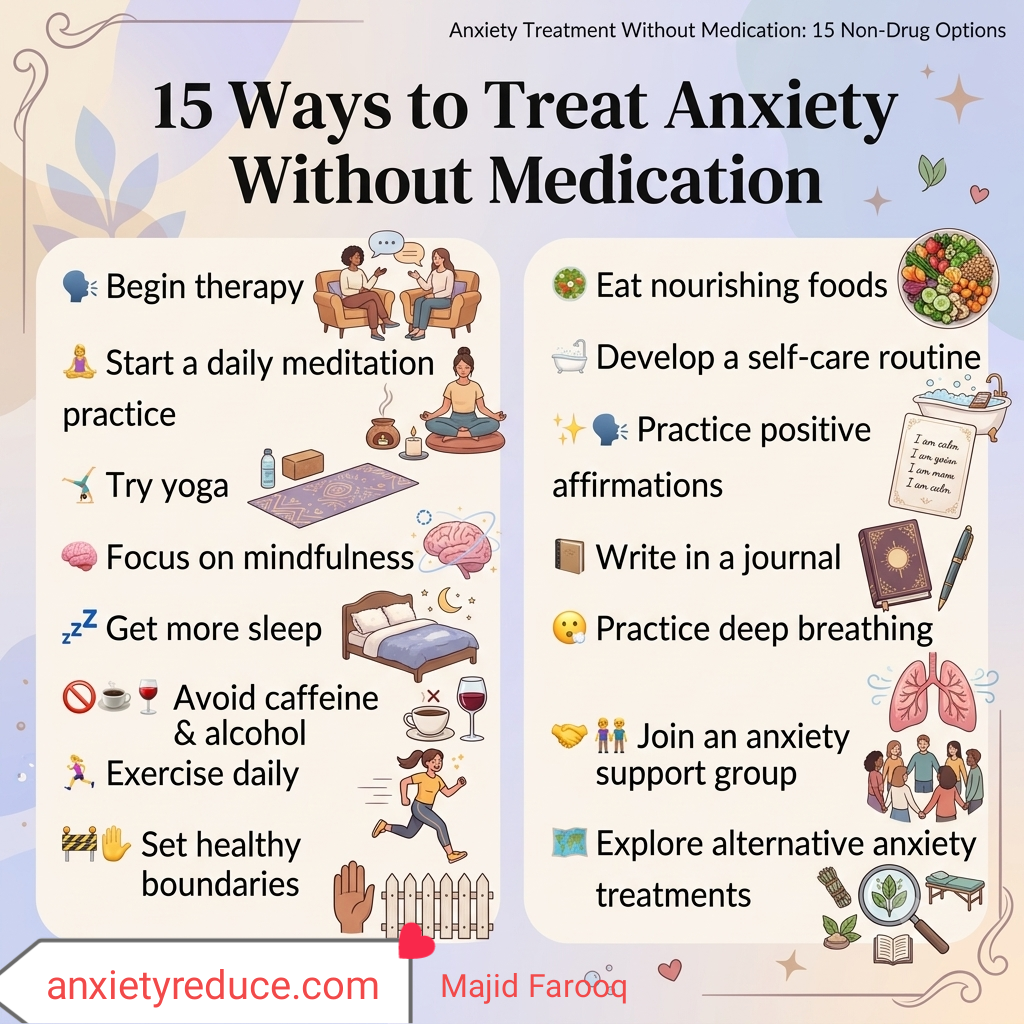
A Quick Comparison of the Methods I Tried
| Method | Time to Feel Results | Cost | Best For |
|---|---|---|---|
| Deep breathing | Minutes | Free | Acute, in-the-moment anxiety |
| Regular exercise | 2–4 weeks | Free–low | Overall anxiety baseline |
| Sleep schedule fixes | 1–3 weeks | Free | Anxiety worsened by fatigue |
| Journaling (structured) | Days–weeks | Free | Racing, repetitive thoughts |
| Reducing screen moment | 1–2 weeks | Free | Anxiety from news/social overload |
| Limiting afternoon caffeine | Days | Free–low | Physical jitteriness, racing heart |
Mistakes I Made Along the Way
I desire to be honest concerning what didn’t job, given that I wasted authentic time on some of it.
- I tried to overhaul everything at once — diet, exercise, sleep, screen moment, meditation — in the same week. I burned out on all of it within ten days. Changing one habit at a period worked far better.
- I used breathing techniques only during panic, at no time practiced them when calm. That’s backwards. Mayo Clinic notes that daily practice, even for a few minutes when you’re not stressed, makes the technique actually usable in the moment you want it.
- I assumed “natural” meant I should avoid talking to anyone around it. I put off seeing a doctor for months given that I thought that meant admitting defeat. It didn’t, and if your anxiety is affecting your daily living, work, or relationships, talking to a professional isn’t a failure of the natural approach — it’s part of taking care of yourself properly.
When Natural Methods Aren’t Enough On Their Own
I’m not going to pretend lifestyle changes fix everything for everyone. If your anxiety is severe, constant, or interfering with your ability to function, please talk to a doctor or licensed therapist. Natural strategies work beautifully alongside professional support — they’re not always a substitute for it, especially with more serious anxiety disorders. If you desire a deeper, structured breakdown of specific natural techniques tailored to different anxiety triggers, I’ve put together more detailed guides over at anxietyreduce.com that go further into each method mentioned here.
Frequently Asked Questions
How long does it take for natural anxiety remedies to job?
Breathing techniques can calm a spike within minutes. Lifestyle changes like exercise, sleep consistency, and reduced screen period usually take two to four weeks of consistency before you notice a genuine shift in your baseline anxiety.
Can diet actually affect anxiety levels?
Diet won’t cure an anxiety disorder, however stabilizing blood sugar (regular meals, less sugar crashing) and watching caffeine intake can reduce physical symptoms that mimic or worsen anxious feelings.
Is exercise really as effective as people say?
The research is genuinely powerful here. Reviews involving well over 100,000 participants have found regular physical activity meaningfully reduces anxiety symptoms, with yoga and mind-body exercise showing particularly solid effects.
Do I need to meditate for an hour a day to see benefits?
No. Even a few focused minutes of breathing or mindfulness daily has measurable benefits, according to Mayo Clinic’s research on mindfulness practices. Consistency matters more than duration.
When should I see a doctor instead of relying only on natural methods?
If anxiety is interfering with job, relationships, sleep, or daily functioning, or if you’re having panic attacks, it’s moment to loop in a professional. Natural methods work well as a foundation, but they’re not a substitute for clinical assist when anxiety is severe.
Final Thoughts
Looking back at that parking lot morning, what I wish someone had told me is that this gets improved in layers, not overnight. Breathing helped in the moment. Exercise and sleep helped over weeks. Cutting the doomscrolling helped quietly, in the background. None of it was a single fix — it was a handful of small, boring, repeatable habits that added up.
If you’re in the middle of your own version of that parking lot moment, begin with just one thing from this set currently. Not all six. One. Provide it two weeks before judging whether it’s working. And if you wish to keep exploring more exact, practical strategies, you’ll discover deeper guides at anxietyreduce.com.
Sources referenced: National Institute of Mental Health (nimh.nih.gov), Harvard Health Publishing (health.harvard.edu), Mayo Clinic (mayoclinic.org).