PECTAA AI Master Trainer Nomination 2026: Punjab Launches Groundbreaking Artificial Intelligence Training for 28,000 Primary Teachers.
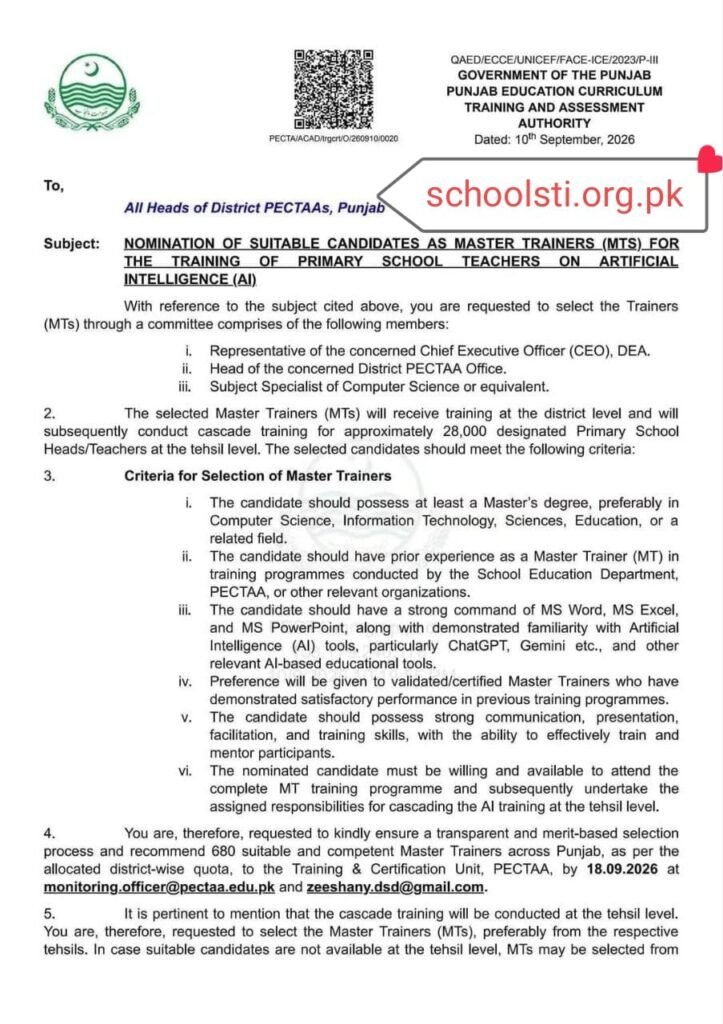
The landscape of foundational communal education in Punjab is undergoing a significant transformation. In an era where technological literacy defines global pedagogical standards, the Punjab Education Curriculum Training and Assessment Authority (PECTAA) has officially initiated a province-wide capacity-building initiative: the Nomination of Suitable Candidates as Master Trainers (MTs) for the Training of Primary School Teachers on Artificial Intelligence (AI).
Issued under official notification reference QAED/ECCE/UNICEF/FACE-ICE/2023/P-III and file number PECTA/ACAD/trgert/O/260910/0020, dated 10th September 2026, this directive outlines the framework to select, upskill, and deploy 680 Master Trainers across all districts of Punjab. These trainers will subsequently lead cascade training sessions at the tehsil standard for approximately 28,000 designated Primary School Heads and Teachers.
For educators, administrators, and educational technology enthusiasts following Punjab School Education Department updates on anxietyreduce.com/, this policy signals an ambitious leap toward integrating modern artificial intelligence tools into foundational classroom learning.
Executive Summary of the PECTAA Directive
The initiative reflects a collaborative framework between provincial bodies and international development partners, aimed at bridging the digital divide in early childhood and primary education. Below is an overview of the key regulatory benchmarks defined in the official circular.
Key Notification Metadata
| Parameter | Official Specification |
|---|---|
| Issuing Authority | Punjab Education Curriculum Training and Assessment Authority (PECTAA), Govt. of the Punjab |
| Notification Reference | QAED/ECCE/UNICEF/FACE-ICE/2023/P-III (PECTA/ACAD/trgert/O/260910/0020) |
| Date of Issuance | 10th September, 2026 |
| Target Cadre to be Selected | 680 Master Trainers (MTs) across Punjab districts |
| Cascade Training Beneficiaries | ~28,000 Primary School Heads and Teachers (PSTs) |
| Selection Level | Tehsil-first preference, processed via District Committees |
| Submission Deadline | 18th September, 2026 |
| Submission Portals | monitoring.officer@pectaa.edu.pk & zeeshany.dsd@gmail.com |
The District Selection Committee Structure
To ensure a merit-based, transparent selection method, PECTAA has mandated that candidate evaluation must not occur arbitrarily. Each district must convene a specialized three-member scrutiny committee comprising:
- Representative of the concerned Chief Executive Officer (CEO), District Education Authority (DEA): Ensures administrative alignment, service record verification, and quota monitoring.
- Head of the concerned District PECTAA Office: Directs curriculum compatibility, training facility logistics, and institutional oversight.
- Subject Specialist of Computer Science (or equivalent): Conducts technical evaluations of applicants’ hands-on proficiency with digital software, modern large language models (LLMs), and prompt generation methodologies.
This multi-stakeholder composition ensures that candidates possess both pedagogical grounding and practical technological competencies.
Eligibility Criteria for AI Master Trainers
The selection standards demand a blend of advanced academic qualifications, practical software mastery, and hands-on familiarity with generative AI platforms.
       [Academic Background]
       Master's in CS, IT, Sciences, Education
                 │
                 ▼
       [Instructional Experience]
       Prior MT track record with SED/PECTAA/QAED
                 │
                 ▼
       [Technical Competence]
       MS Office + Generative AI (ChatGPT, Gemini, etc.)
                 │
                 ▼
       [Communication & Facilitation]
       Proven mentoring ability & commitment to tehsil cascade
1. Educational Credentials
- Applicants must hold at least a Master’s degree (or 16 years of equivalent education).
- Direct preference is given to graduates in Computer Science, Information Technology, Natural Sciences, or Education.
2. Prior Training & Facilitation Experience
- Demonstrable prior experience as a Master Trainer (MT) under training programs led by the School Education Department (SED), PECTAA (formerly QAED/DSD), or recognized partner organizations.
- Preference is granted to validated and certified Master Trainers who hold documented satisfactory evaluations from previous provincial training cohorts.
3. Digital Competence and AI Tool Literacy
Unlike conventional instructor training modules, this program establishes exact technical criteria:
- Productivity Suites: Advanced operating command of Microsoft Word, Microsoft Excel, and Microsoft PowerPoint for developing instructional materials, tracking student assessments, and delivering presentations.
- Artificial Intelligence Expertise: Practical familiarity with state-of-the-art conversational AI tools, particularly OpenAI ChatGPT and Google Gemini, as well as specialized educational AI applications used for adaptive quiz generation, lesson planning, and contextualized pedagogical illustrations.
- Global frameworks, such as the UNESCO Guidance for Generative AI in Education and Research, emphasize that educator AI literacy must encompass ethical prompting, fact-checking, and critical evaluation—competencies prioritized under PECTAA’s selection guidelines.
4. Availability and Geographic Anchoring
- Candidates must provide an unconditional commitment to whole the centralized district-stage training and subsequently execute the cascading phases at assigned tehsil centers.
- Tehsil-Level Preference: Candidates residing in or posted within their respective tehsils will be prioritized to minimize travel overhead and guarantee continuity during the cascade phase.
Cascade Training Model: Scaling AI to 28,000 Teachers
Deploying technology instruction across 36+ districts requires a structured, two-tier cascade architecture. This approach balances centralized caliber control with broad decentralized reach.
┌─────────────────────────────────────────────────────────────┐
│                 Centralized Tier: District Level            │
│       680 Selected MTs receive immersive training on        │
│          AI workflows, prompt literacy & ethics             │
└──────────────────────────────┬──────────────────────────────┘
                               │
                               ▼
┌─────────────────────────────────────────────────────────────┐
│                 Decentralized Tier: Tehsil Level            │
│       680 MTs cascade hands-on workshops to ~28,000         │
│          Primary School Heads and Teachers (PSTs)           │
└─────────────────────────────────────────────────────────────┘
- Tier 1 (District Level): The 680 nominated Master Trainers undergo specialized coaching led by curriculum designers, computer science specialists, and international development consultants. This phase focuses on hands-on prompt design, digital ethics, lesson plan synthesis, and interactive teaching techniques.
- Tier 2 (Tehsil Level): Master Trainers return to their local tehsils to deliver practical workshops to 28,000 primary institution educators. Training takes site in designated computer laboratories and smart classrooms across tehsils to ensure participants gain direct, hands-on terminal experience.
This cascade approach reflects broader international initiatives, such as UNICEF’s Global Digital Learning Frameworks, which highlight local teacher mentoring as the most cost-effective lever for scalable digital education reform.
Comparison: Traditional In-Service Teacher Training vs. PECTAA AI-Enabled Training
To grasp the scope of this intervention, it is useful to compare PECTAA’s upcoming AI curriculum with conventional in-service training models previously administered across Punjab.
| Dimension | Traditional In-Service Training (e.g., CPD / Induction) | PECTAA AI Capacity Building (2026) |
|---|---|---|
| Primary Medium | Printed modules, static lecture slides, manual activity booklets | Digital interfaces, interactive LLM prompts, live generative software |
| Lesson Plan Preparation | Manual drafting requiring hours of template population | Prompt-assisted scaffolding tailored to multi-grade primary classrooms |
| Teaching Aid Generation | Hand-drawn charts, static physical flashcards | AI-assisted visual generation, customized bilingual reading passages |
| Assessment Formulation | Standardized, one-size-fits-all paper tests | Differentiated assessment questions categorized by pupil ability tiers |
| Pedagogical Focus | Rote material repetition and basic compliance tracking | Digital literacy, cognitive scaffolding, and ethical tech adoption |
| Trainer Profile | General subject educators with basic administrative training | Validated IT/CS specialists and tech-literate certified Master Trainers |
Strategic Curriculum Application: What AI Means for Primary Classrooms
Deploying artificial intelligence tools to primary institution teachers addresses several fundamental classroom challenges in open schools:
- Automated Multi-Grade Lesson Differentiation: Primary educators in rural Punjab frequently oversee multi-grade classrooms. Using conversational AI, teachers can generate differentiated reading exercises and worksheets targeted at distinct learning levels in seconds.
- Localized Bilingual Content Synthesis: Primary instruction benefits heavily from bridging English terminology with contextual Urdu or regional idioms. Conversational AI facilitates immediate bilingual translation, vocabulary matching, and phonetic drill development.
- Administrative Burden Reduction: Formulating monthly progress summaries, diagnostic quizzes, and parent-teacher meeting notes can be streamlined using structured prompts, freeing instructional hours for direct pupil engagement.
- Alignment with Global Trends: As highlighted by the World Economic Forum’s Education and AI Analysis, early integration of cognitive digital tools enables educators to transition from passive rote instructors to active classroom learning facilitators.
Teachers preparing for the selection operation can review standard diagnostic materials and curricula on the anxietyreduce.com/ educational resources library.
Key Deadlines & Nomination Submission Guidelines
District PECTAA heads and regional DEAs must adhere to a tight operational schedule:
- Official Notification Date: 10th September, 2026
- District Scrutiny & Nomination Window: 10th September – 17th September, 2026
- Final Dossier Submission Deadline: 18th September, 2026
- Official Submission Addresses:
monitoring.officer@pectaa.edu.pkzeeshany.dsd@gmail.com
Nominating authorities must transmit consolidated lists reflecting their allotted district quotas. Nominations must comprise proof of academic degrees, prior MT experience certificates, and verified contact details to facilitate immediate onboarding by PECTAA’s Training & Certification Unit.
Frequently Asked Questions (FAQs)
Who is eligible to be nominated as a Master Trainer (MT) under this PECTAA program?
Applicants must hold at least a Master’s degree (preferably in Computer Science, IT, Sciences, or Education), possess prior Master Trainer experience with the School Education Department or PECTAA, display fluency in MS Office, and demonstrate hands-on experience using AI tools like ChatGPT and Google Gemini.
How several Master Trainers are being recruited across Punjab?
A total of 680 Master Trainers will be selected across all districts based on allocated district quotas.
Who constitutes the selection committee at the district level?
The committee consists of three members: a representative of the Chief Executive Officer (CEO) of the District Education Authority, the Head of the District PECTAA Office, and a Subject Specialist in Computer Science or an equivalent technical field.
What is the primary role of the selected Master Trainers?
Master Trainers will full specialized district-degree orientation and subsequently conduct decentralized cascade training for approximately 28,000 Primary School Heads and Teachers at the tehsil level.
Where should district offices submit their recommended nominations?
Completed nomination lists must be emailed to monitoring.officer@pectaa.edu.pk and zeeshany.dsd@gmail.com by no later than 18th September, 2026.
Analysis
PECTAA’s directive highlights several important shifts in provincial educational strategy:
- Institutional Evolution: The transition of QAED/DSD structures under the PECTAA umbrella demonstrates a push to align curriculum formulation, educator training, and student assessment within a single unified administrative body.
- Targeting Foundational Tiers First: While technological capacity building is frequently reserved for higher secondary or tertiary tiers, targeting primary academy teachers addresses the roots of early learning. Equipping primary educators with AI-assisted formative tools helps tackle early grade learning losses and multi-grade teaching challenges.
- Hyper-Local Delivery: By emphasizing tehsil-standard selection and deployment, the program reduces logistical friction, lowers transit expenditures, and ensures sustained local peer assist once the formal training conclude.
- Implementation Risks: The project’s success depends heavily on infrastructure realities. Several primary schools across rural Punjab face intermittent electricity, lack computer laboratories, and have restricted internet connectivity. Without reliable offline workflows or mobile-friendly accommodations, classroom-stage adoption could face operational hurdles.
Opinion
PECTAA’s initiative to equip 28,000 primary educators with generative AI literacy is a forward-thinking and commendable step. In developing educational ecosystems, administrative workloads and crowded classrooms frequently limit individual student attention. Generative AI offers practical potential to assist with lesson planning, worksheet customization, and language scaffolding.
Nevertheless, three key considerations will determine the initiative’s long-term impact:
- Beyond Superficial Prompting: Training must move past basic prompt generation (such as “write an essay on pollution”) and focus on pedagogical problem-solving. Teachers want instruction in diagnostic assessment, identifying algorithmic hallucinations, protecting learner privacy, and designing localized classroom activities.
- Bridging the Infrastructure Gap: Training primary school heads on cloud-based generative models yields limited value if schools lack steady power and internet access. PECTAA should pair this curriculum with lightweight, low-bandwidth, and offline-compatible educational tools.
- Transparent Evaluation: The three-member selection committee must maintain rigorous technical standards during the nomination window ending September 18, 2026. Selecting Master Trainers based on verified digital competence—rather than administrative seniority—will be critical to the program’s success.
If implemented with technical rigor and sustained post-training assist, this program could establish Punjab as a regional pioneer in open-sector AI-assisted basic education.
Conclusion
The PECTAA notification of 10th September 2026 marks a milestone in modernizing Punjab’s open academy setup. By selecting 680 qualified Master Trainers to instruct 28,000 primary institution educators, the School Education Department is establishing the groundwork for technology-assisted foundational learning. Eligible educators possessing the required academic credentials, instructional experience, and AI literacy should coordinate promptly with their respective District PECTAA heads and DEAs before the 18th September 2026 submission deadline.