SED Punjab Issues High-Priority Directive on BISE 9th Class Results: Merit Badges for Top Performers and PEEDA Proceedings for Under 20% Pass Rates.
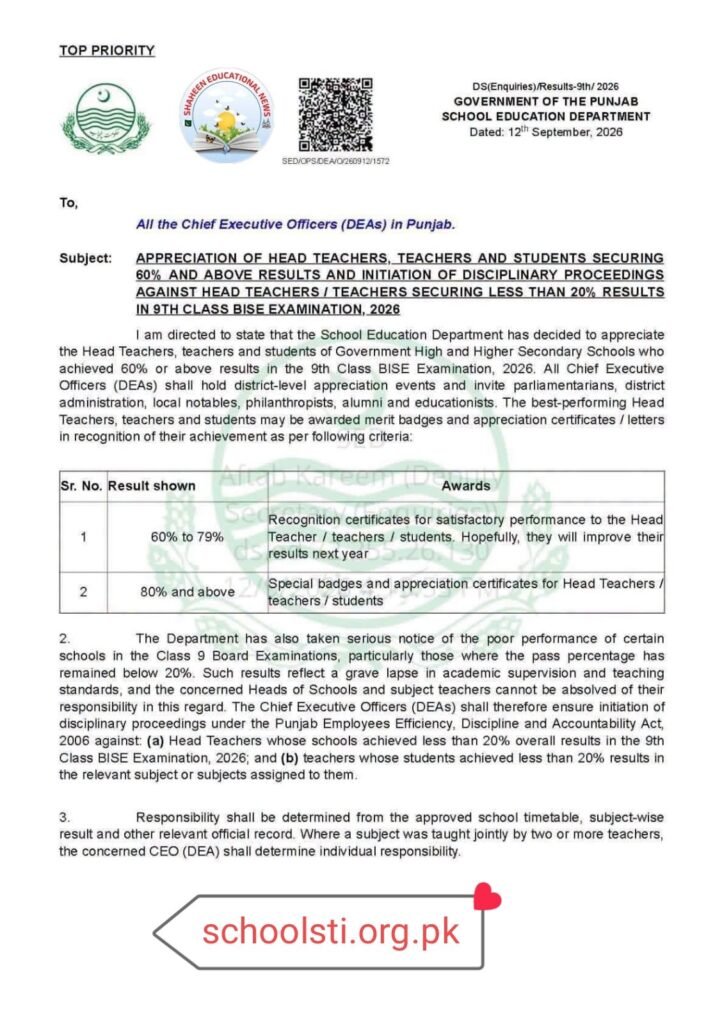
The Government of the Punjab School Education Department (SED) has officially issued a landmark directive regarding school performance in the 9th Class Board of Intermediate and Secondary Education (BISE) Annual Examinations. Circulated under notification number DS(Enquiries)/Results-9th/2026 (SED/OPS/DEA/O/260912/1572) and dated September 12, the order establishes a dual framework of institutional reward and disciplinary accountability across all 36 districts of the province.
Addressed to all Chief Executive Officers of District Education Authorities (DEAs), the directive establishes high-profile communal honors for educators and students demonstrating high academic achievement, while simultaneously mandating formal disciplinary inquiries under the Punjab Employees Efficiency, Discipline and Accountability Act, 2006 against head teachers and subject instructors showing sub-20% pass rates.
Here is an exhaustive breakdown of the policy mandates, institutional mechanisms, grading thresholds, and procedural actions set forth by the department.
Key Highlights of the SED Notification
- Two-Tiered Recognition Model: Schools, head teachers, subject specialists, and students achieving pass percentages of 60% and above receive formal recognition, with tiered awards for 80%+ performance.
- Public District-Level Galas: District Education Authorities must arrange dedicated award ceremonies featuring civil society, alumni, and parliamentarians.
- Strict Accountability Under PEEDA Act, 2006: Mandatory initiation of formal legal inquiries against head teachers with academy pass percentages below 20%, as well as individual subject teachers whose assigned courses dropped below 20%.
- Bifurcated Disciplinary Jurisdiction: District authorities maintain inquiry authority for personnel in Basic Pay Scale (BS) 16 and below, while higher-grade officers (BS-17 and above) are referred directly to the provincial secretariat.
- Fortnightly Progress Reporting: CEOs must submit bi-weekly implementation updates directly to the Director Public Instruction (Secondary Education) Punjab, under a designated “Top Priority” classification.
Educators tracking official circulars and state gazettes can review whole administrative releases on SchoolsTI.
Rewarding Academic Excellence: Criteria for Appreciation
Under Paragraph 1 of the official circular, the department acknowledges that positive reinforcement is critical for sustaining academic performance in authority secondary institutions. All heads of schools, teachers, and enrolled students who crossed the 60% success threshold in the 9th Class examinations administered by the respective Punjab Boards of Intermediate and Secondary Education (BISE) are eligible for formal honors.
Tier 1: Satisfactory Performance (60% to 79%)
Head teachers, subject teachers, and students achieving an aggregate or subject-level pass rate between 60% and 79% are awarded Recognition Certificates for Satisfactory Performance. The explicit institutional goal outlined by the department is to incentivize these schools to push their results past the 80% mark in upcoming exam cycles.
Tier 2: Outstanding Performance (80% and Above)
Educational institutions and teaching staff delivering 80% or greater success rates receive Special Badges of Merit alongside customized Appreciation Certificates / Letters.
┌─────────────────────────────────────────────────────────────┐
│                 SED Merit Recognition Model                 │
├───────────────────┬─────────────────────────────────────────┤
│ Pass Percentage   │ Form of Institutional Recognition       │
├───────────────────┼─────────────────────────────────────────┤
│ 60% to 79%        │ Recognition Certificates                │
│ 80% and Above     │ Special Badges + Appreciation Letters   │
└───────────────────┴─────────────────────────────────────────┘
Community Engagement and Public Recognition Ceremonies
Rather than confining commendations to internal departmental letters, the directive instructs each CEO (DEA) to convene structured district-degree appreciation ceremonies. To rebuild open trust in government institution standards, these events must actively incorporate external civic stakeholders, including:
- Members of Provincial and National Assemblies (Parliamentarians)
- District administrative leadership (Commissioners and Deputy Commissioners)
- Prominent local philanthropists and community notables
- School alumni networks and distinguished educationists
Accountability for Poor Results: Invoking the PEEDA Act, 2006
Paragraph 2 of the order highlights serious concern over public schools where 9th Class pass rates failed to reach 20%. The department officially categorizes such outcomes as a “grave lapse in academic supervision and teaching standards,” explicitly noting that administrative heads and subject instructors cannot be absolved of operational responsibility.
CEOs of all District Education Authorities have been instructed to initiate formal disciplinary proceedings under the Punjab Employees Efficiency, Discipline and Accountability (PEEDA) Act, 2006 against two distinct categories of staff:
- Institutional Heads: Head Teachers whose schools registered an overall institutional pass rate below 20%.
- Subject Instructors: Teachers whose enrolled students collectively secured less than 20% results in their specifically assigned curriculum subject(s).
Establishing Evidentiary Responsibility
To ensure fair adjudication and prevent arbitrary penalization, the notification establishes precise parameters for fixing liability:
- Official class timetables approved at the start of the academic session.
- Gazette notifications and subject-wise official outcome cards issued by the BISE.
- Relevant institutional registers and attendance ledgers.
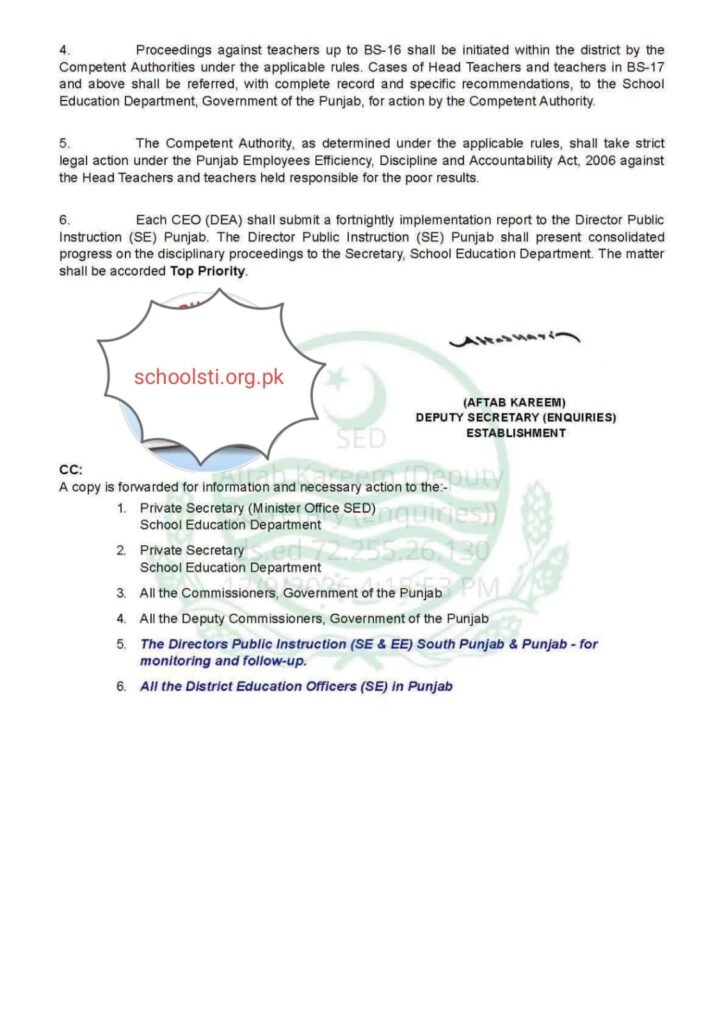
Where a subject was assigned to two or more instructors simultaneously, the concerned CEO (DEA) must carry out a factual inquiry to apportion individual responsibility based on class sections and assigned lecture quotas.
Procedural Workflow: BS-16 vs. BS-17 and Above
The notification delineates authority lines to ensure inquiries align with statutory civil service rules in the province:
| Cadre / Basic Pay Scale (BS) | Competent Authority | Procedural Jurisdiction & Action Required |
|---|---|---|
| Teachers up to BS-16 (e.g., PSTs, ESTs, SSTs) | District Authorities (CEO DEA / DEO) | Proceedings initiated, heard, and concluded entirely within the district under applicable service rules. |
| Officers BS-17 and Above (e.g., Headmasters, Subject Specialists, Principals) | Secretary, School Education Department Punjab | Complete inquiry files, evidentiary dossiers, and particular punitive recommendations must be submitted to the provincial secretariat. |
Implementation and Monitoring Framework
To prevent bureaucratic delays, Paragraph 6 introduces a period-bound monitoring loop:
- Fortnightly Submission: Every CEO (DEA) must compile and dispatch a bi-weekly status report to the Director Public Instruction (Secondary Education) Punjab.
- Provincial Consolidation: The DPI (SE) compiles a province-wide master report detailing active inquiries, charges framed, and penalties proposed.
- Executive Oversight: The consolidated review is submitted directly to the Secretary, School Education Department.
- Administrative Precedence: The implementation procedure carries a strict “Top Priority” governance tag.
Comparative Analysis: Positive Incentives vs. Punitive Governance
The dual-track mechanism reflects an intentional shift in communal-sector educational administration. Below is a comparative breakdown of how the two prongs operate in practice:
| Operational Dimension | Excellence Track (60%+ / 80%+) | Accountability Track (<20%) |
|---|---|---|
| Primary Objective | Boost instructor morale, construct academy pride, incentivize retention | Eliminate administrative neglect, ensure minimum academic standards |
| Primary Mechanism | Merit badges, district ceremonies, civic visibility | Formal inquiries under PEEDA Act 2006, service file entries |
| Target Population | Top-performing students, high-yield subject educators, proactive heads | Underperforming head teachers, instructors with sub-20% pass rates |
| Community Role | Civic honor, engagement of alumni and parliamentarians | Administrative audit, departmental accountability |
| Systemic Risk | Risk of superficial ceremony if continuous assist is absent | Risk of lower-tier scapegoating if systemic deficits are ignored |
Frequently Asked Questions (FAQs)
What triggers disciplinary action under this modern SED notification?
Disciplinary action under the PEEDA Act, 2006 is triggered if a institution’s overall 9th Class BISE outcome falls below 20%, or if a educator’s exact assigned subject pass percentage falls below 20%.
Can a educator be penalized if the institution as a whole passed?
Yes. Paragraph 2(b) explicitly targets individual subject teachers whose assigned course results fall below 20%, irrespective of whether other subjects or the school overall achieved passing marks.
How is responsibility assigned if multiple teachers taught the same course?
The CEO (DEA) must examine the approved institutional timetable, section allotments, and teacher registers to determine individual workloads and assign proportionate responsibility.
Who acts as the Competent Authority for Headmasters in BS-17 and BS-18?
For staff in BS-17 and above, the district authorities compile the evidence and forward the cases with particular recommendations to the School Education Department at the provincial secretariat level, where the Secretary SED serves as the Competent Authority.
Where can educational professionals access official templates and circular updates?
Verified education department circulars, examination schedules, and service policy updates are regularly indexed on the SchoolsTI official notifications portal.
Analysis
The September 12 directive signals three significant administrative developments within Punjab’s education structure:
- Targeting Marginal Performance Bands: By setting distinct thresholds at 60%, 80%, and <20%, the department moves away from broad generalizations, establishing clear statistical benchmarks for personnel evaluations.
- Decentralized Execution with Central Oversight: Leaving initial inquiries for BS-16 staff to local districts while maintaining fortnightly reporting to the provincial DPI creates a balance between administrative agility and centralized accountability.
- Closing Collective Responsibility Loopholes: Mandating timetable-based audits for co-taught courses prevents staff from shifting blame, tying individual classroom performance directly to legal accountability under service laws.
Opinion
The School Education Department’s policy represents a required, performance-driven approach in an educational ecosystem where low pass rates in secondary examinations have commonly gone unaddressed. Coupling merit badges with statutory accountability under the PEEDA Act creates evident stakes for public academy administration.
However, departmental leadership must apply these disciplinary measures judiciously. Low pass percentages can regularly stem from broader systemic constraints—such as prolonged staff vacancies in science subjects, missing laboratory equipment, or extreme pupil-teacher ratios in rural institutions. While holding staff accountable for negligent teaching is essential, DEAs must ensure that statutory inquiries distinguish between professional misconduct and institutional resource deficits before imposing formal penalties under civil service rules.
Conclusion
The School Education Department’s directive sets a apparent precedent for secondary education across Punjab. By celebrating academic excellence in general forums and initiating rigorous statutory reviews for severe underperformance, the department aims to establish measurable accountability across its secondary academy network. All eyes now turn to the Chief Executive Officers of the District Education Authorities as the primary cycle of fortnightly implementation reports reaches the provincial secretariat.