EDGE Punjab Two-Day Head Teacher Training 2026: Official Schedule, District Breakdown, and Implementation Guide
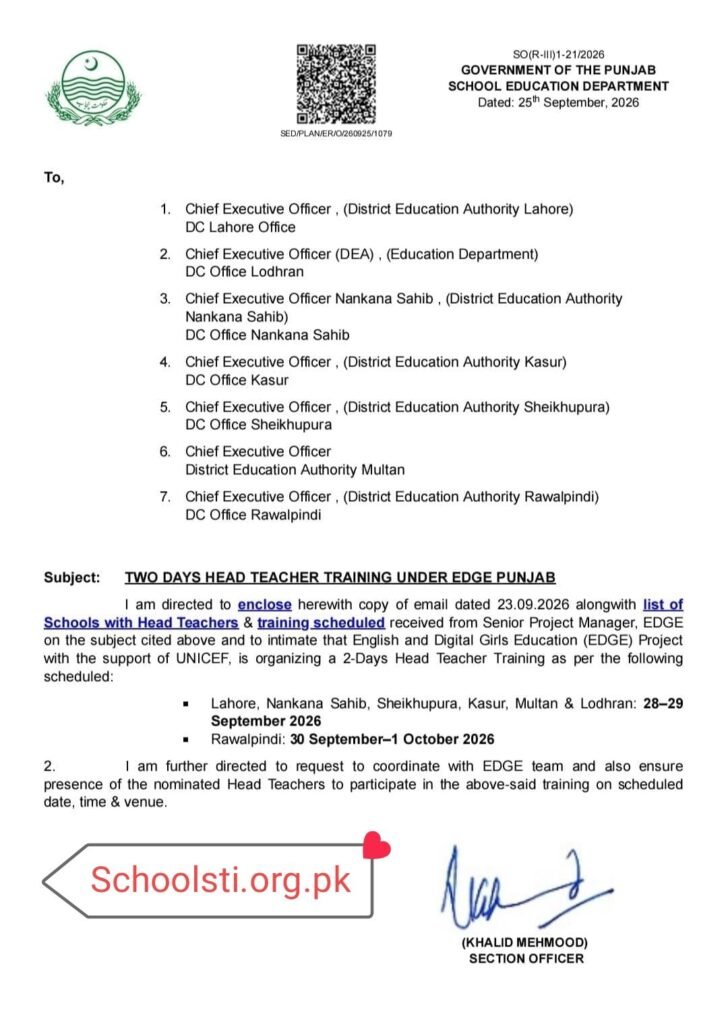
The School Education Department (SED), Government of the Punjab, has officially issued notification SO(R-III)1-21/2026 announcing a comprehensive Two-Day Head Teacher Training under the English and Digital Girls Education (EDGE) Project. Executed in collaboration with UNICEF Pakistan, this initiative aims to empower institution administrators across selected districts with the leadership, linguistic, and technological skills required to institutionalize digital learning for female students.
As educational institutions adapt to technology-driven pedagogy, building administrative capacity at the grassroots stage has become essential. This guide provides a detailed breakdown of the official notification, district-standard schedules, administrative mandates, and the long-term educational objectives of the EDGE initiative in Punjab.
Key Highlights of the SED Notification
| Field | Detail / Official Reference |
|---|---|
| Issuing Authority | Punjab School Education Department |
| Notification Number | SO(R-III)1-21/2026 |
| System Tracking ID | SED/PLAN/ER/O/260925/1079 |
| Date of Issuance | 25th September, 2026 |
| Program Title | Two Days Head Teacher Training Under EDGE Punjab |
| Supporting Partner | UNICEF |
| Target Participants | Nominated Head Teachers of designated secondary & elementary schools |
| Participating Districts | Lahore, Nankana Sahib, Sheikhupura, Kasur, Multan, Lodhran, Rawalpindi |
District Distribution and Training Schedule
The department has structured the capacity-building program into two distinct phases to facilitate regional coordination and resource allocation across North, Central, and South Punjab.
Chief Executive Officers (CEOs) of the relevant District Education Authorities (DEAs) have been instructed to liaise directly with the EDGE project team and ensure 100% attendance of designated head teachers.
Training Schedule Table
| Phase | Districts Covered | Scheduled Dates | Administrative Focal Point |
|---|---|---|---|
| Phase I | Lahore, Nankana Sahib, Sheikhupura, Kasur, Multan, Lodhran | 28–29 September 2026 | Relevant DEA CEO / DC Office |
| Phase II | Rawalpindi | 30 September – 01 October 2026 | DEA Rawalpindi / DC Office |
For verified lists of participating institutions and administrative circulars, educators can review the latest Punjab academy administration notifications on SchoolsTI.
Core Pillars of the EDGE Punjab Initiative
The English and Digital Girls Education (EDGE) program targets systemic challenges faced by female learners in open schools, particularly limited access to digital infrastructure and language development programs. Supported globally and regionally through partners like UNICEF and initiatives tracked by British Council Pakistan Education, EDGE centers on three key educational components:
1. Digital Literacy and IT Readiness
The program introduces structured modules on digital competency, covering basic operating systems, online educational resources, educational applications, and cyber safety practices. This equips teachers and students to use digital labs beyond simple data entry.
2. English Language Proficiency
By integrating digital learning aids and interactive English modules, the project enhances communicative competence among students, reducing the disparity between private and general schooling outcomes.
3. Leadership and Institutional Ownership
Equipping head teachers with digital oversight competencies ensures that computer laboratories and smart classrooms do not fall into disuse. Administrators learn how to supervise technical sessions, maintain lab records, and integrate digital periods into regular timetables.
Comparative Analysis: Traditional Administration vs. EDGE Leadership Model
The shift from conventional paper-bound academy management to digitally integrated leadership represents a fundamental reform in communal institution management.
| Parameter | Conventional School Administration | EDGE-Enabled Digital Leadership |
|---|---|---|
| Classroom Monitoring | Purely physical, periodic observations | Blended: tracking digital lab utilization and portal progress |
| Curriculum Delivery | Rote memorization via standard textbooks | Multi-modal learning via audio-visual tools and interactive modules |
| Language Acquisition | Grammar-translation method with limited verbal practice | Self-paced interactive digital language labs |
| Resource Management | Static stock registers for equipment | Active maintenance tracking and digital asset maximization |
| Gender-Responsive Support | General administrative oversight | Dedicated focus on digital access and risk-free learning for girls |
Administrative Directives for Nominated Head Teachers
To ensure seamless execution, head teachers and district officials must fulfill the following operational guidelines before and during the workshops:
- Verification of Nomination Lists: School heads must cross-check their institutional nomination via their respective DEA office or through official educational updates on SchoolsTI.
- Relieving Orders and Charge Handover: Internal administrative arrangements must be made to maintain daily school discipline and classroom instruction during the two-day absence.
- Punctuality and Full Attendance: The notification explicitly mandates full presence across both scheduled days; partial attendance will not be accepted by district monitoring units.
- Post-Training Action Plan: Following the training, attendees are expected to formulate an implementation roadmap for their respective schools, including learner batch scheduling and IT lab readiness audits.
Frequently Asked Questions (FAQs)
What is the primary purpose of the EDGE training?
The training prepares head teachers in selected Punjab districts to oversee and implement the English and Digital Girls Education (EDGE) framework, focusing on digital literacy, English language learning, and girls’ educational empowerment.
Which districts are included in the primary phase?
Phase I runs on 28–29 September 2026 and includes six districts: Lahore, Nankana Sahib, Sheikhupura, Kasur, Multan, and Lodhran.
Why is Rawalpindi scheduled separately?
Rawalpindi is scheduled for 30 September – 01 October 2026 to permit specialized regional logistics and dedicated technical facilitation tailored to Northern Punjab’s institution cluster.
Is attendance mandatory for all nominated head teachers?
Yes. The notification signed by the Section Officer directs CEOs to coordinate with the EDGE management team and ensure the mandatory presence of all nominated institutional heads.
Analysis
The notification issued under reference SO(R-III)1-21/2026 reflects a targeted strategy to address the gender digital divide within the general academy framework. Key structural observations comprise:
- Targeted Geographic Reach: Spanning both high-density central districts (Lahore, Kasur, Sheikhupura) and southern agrarian belts (Multan, Lodhran), the program addresses diverse socioeconomic contexts.
- Top-Down Administrative Buy-In: By training academy heads rather than solely IT instructors, the School Education Department ensures administrative hurdles—such as locked computer labs and scheduling conflicts—are resolved by academy leadership directly.
- Multi-Agency Synergy: Combining departmental authority with UNICEF technical and development back provides standardized pedagogical materials that align with international development standards.
Opinion
Targeting head teachers is a necessary step for sustainable educational technology adoption. Historically, computer labs in general schools across Punjab have suffered from underutilization due to risk aversion, lack of technical knowledge among senior staff, and rigid administrative routines.
Still, a two-day workshop is an introduction, not a comprehensive solution. For EDGE to deliver lasting improvements in pupil learning outcomes, the department must follow this administrative orientation with:
- Dedicated, quarterly technical refreshers for lab instructors;
- Reliable internet connectivity and hardware maintenance budgets;
- Continuous monitoring through the Chief Minister’s School Education Reform dashboards.
Investing in institutional leaders sets the right tone. If followed by rigorous on-ground monitoring and functional school infrastructure, this initiative can tangibly upgrade digital access and functional literacy for female students across Punjab.