PECTAA First-Term School-Based Assessment (SBA) 2026–27: Complete Date Sheet, Syllabus & Paper Pattern (Grades 1–8)
The Punjab Education Curriculum Training and Assessment Authority (PECTAA) has officially notified the schedule, standard operating procedures (SOPs), paper pattern, and date sheet for the First-Term School-Based Assessment (SBA) 2026–27 covering Grades 1 through 8. Distributed to all Chief Executive Officers of District Education Authorities (CEOs-DEAs) across Punjab under notification number AD(A&E)/SBA/FT/117/2026, this directive establishes uniform evaluation standards across all open schools in the province.
This in-depth guide covers everything educators, school heads, parents, and students need to realize: the official timeline, the Item Bank System (IBS) workflow, grade-wise marks weightage, single-page paper specifications, shift timings, the master date sheet, and practical compliance protocols.
Key Highlights of the First-Term SBA 2026–27 Notification
- Target Classes: Grade 1 to Grade 8 across all Punjab public schools.
- Item Bank System (IBS) Activation: 14th September 2026.
- Paper Generation Window: 14th to 17th September 2026.
- Examination Window: 18th to 30th September 2026.
- Result Uploading on SIS: 4th October 2026.
- Parent-Teacher Meeting (PTM) & Report Card Distribution: 5th October 2026.
- Assessment Framework: Standardized question generation via IBS with unique academy EMIS and scannable QR codes.
- Regulatory Authorities: Jointly supervised and inspected by PECTAA and the Punjab School Education Department.
Official Activity Schedule: First-Term SBA 2026–27
School heads and administrators must adhere strictly to the operational timeline communicated by PECTAA to ensure seamless paper generation, smooth exam administration, and timely reporting.
| Sr. No. | Milestone / Activity | Prescribed Schedule |
|---|---|---|
| 1 | Uploading of Item Bank on IBS | 14 September 2026 |
| 2 | Paper Generation by Schools via IBS Login | 14 to 17 September 2026 |
| 3 | Conduct & District-Wide Monitoring of First-Term SBA | 18 to 30 September 2026 |
| 4 | Paper Marking & Student Report Card Preparation | 18 September to 04 October 2026 |
| 5 | Mandatory Result Uploading on SIS Portal | 04 October 2026 |
| 6 | Parent-Teacher Meeting (PTM) & Result Sharing | 05 October 2026 |
For additional administrative circulars and regional updates, educators can reference recent School Education Department notifications on anxietyreduce.com/.
Standard Operating Procedures (SOPs) & Paper Generation Guidelines
PECTAA has laid down obvious Standard Operating Procedures (Flag-A) governing the technical and administrative conduct of the First-Term SBA:
1. Item Bank System (IBS) and QR Code Security
Every open school is required to log into the official Punjab Examination Commission / PECTAA Item Bank System using their dedicated credentials.
- Each generated paper contains an auto-generated QR code embedding the school’s whole identity, including its official Education Management Information System (EMIS) code.
- The authenticity of the paper can be confirmed instantly on-site via any standard QR scanner app.
2. Single-Page Paper Layout (Grades 3 to 8)
To conserve institutional paper resources and maintain neatness, all query papers for Grades 3 through 8 are restricted to a single page with accompanying marking keys and standardized scoring rubrics generated directly from the IBS portal.
3. Language & Medium Options
All papers will be provided bilingually (English and Urdu), except for exact language and religious education subjects:
- Exempt from Bilingual Format: English, Urdu, Tarjuma-tul-Quran-ul-Majeed, and Ethics.
- School Discretion: Schools maintain the institutional autonomy to print and generate universal subjects in either English or Urdu medium based on their medium of instruction.
4. Early Childhood & Lower Primary Format (Grades 1 & 2)
Assessment for Grades 1 and 2 is predominantly oral, divided into five discrete sections evaluated at 10 marks each (Total: 50 marks).
- To assess foundational literacy, English and Urdu each trait one written question.
- Schools must print one two-page colored question sheet per subject strictly for the educator’s apply; students are not handed full query sheets.
- Listening, speaking, and reading skills are assessed on the designated examination day according to explicit rubric benchmarks.
5. Optional Subjects Framework
Where optional subjects are offered, institutions must self-author assessment papers adhering strictly to the PECTAA standard: 10 MCQs (15 marks) and 3 Constructed Response Questions (CRQs) (35 marks), totaling 50 marks.
6. Archiving & SIS Verification
Before issuing physical report cards, institution heads must upload all pupil results to the official School Information System (SIS Punjab). Physical response scripts, alongside printed keys and rubrics, must be maintained in secure institution custody for audit and inspection by visiting provincial monitoring teams.
Syllabus Structure and Paper Pattern (Grades 1 to 8)
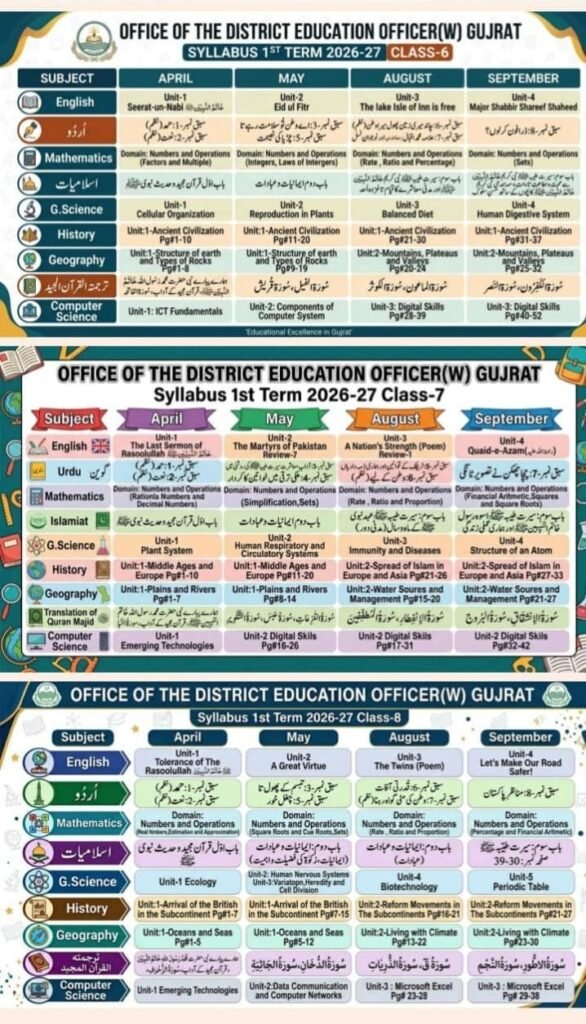
The First-Term SBA evaluates the curriculum taught during the opening term as outlined in the official Academic Calendar. The total weightage for each subject across all grades is set at 50 marks.
                           SBA Marks Distribution
                                (50 Marks)
                                    │
       ┌────────────────────────────┼────────────────────────────┐
       ▼                            ▼                            ▼
  Grades 1 & 2                 Grades 3 to 5                Grades 6 to 8
  Oral Evaluation              Balanced Split               Analytical/CRQ Focus
  5 Tasks × 10 Marks           10 MCQs: 20 Marks            10 MCQs: 15 Marks
  (1 Written item in Lang.)    3 CRQs:  30 Marks            3 CRQs:  35 Marks
Grade-Wise Examination Architecture
| Grade Bracket | Assessment Format | Item Breakdown & Question Types | Marks Weightage | Total Marks |
|---|---|---|---|---|
| Grades 1 & 2 | Primarily Oral (Interactive Rubrics) | • MCQs (Oral): 10 Marks |
• Fill in the Blanks: 10 Marks
• True / False: 10 Marks
• Column Matching: 10 Marks
• Short Question / Writing (English/Urdu): 10 Marks | 5 sections × 10 marks each | 50 Marks |
| Grades 3 to 5 | Written Assessment (Single Page) | • Multiple Choice Questions (10 MCQs)
• Constructed Response Questions (3 CRQs) | • MCQs: 20 Marks
• CRQs: 30 Marks | 50 Marks |
| Grades 6 to 8 | Written Assessment (Single Page) | • Multiple Choice Questions (10 MCQs)
• Constructed Response Questions (3 CRQs) | • MCQs: 15 Marks
• CRQs: 35 Marks | 50 Marks |
| Optional Subjects | Written (School Developed) | • Multiple Choice Questions (10 MCQs)
• Constructed Response Questions (3 CRQs) | • MCQs: 15 Marks
• CRQs: 35 Marks | 50 Marks |
Educators seeking structured question banks, model formats, and classroom evaluation aids can explore specialized exam paper generators and academic resources on anxietyreduce.com/.
Official Shift Timings
Schools operate on standard morning or afternoon shifts depending on their institutional structure:
- Morning Shift: 10:00 AM to 12:00 PM
- Afternoon Shift: 01:30 PM to 03:30 PM
- Friday Afternoon Shift Adjustment: 02:00 PM to 04:00 PM
Master Date Sheet: First-Term SBA 2026–27 (Grades 1 to 8)
The table below compiles the full provincial date sheet as notified by PECTAA, running from Friday, 18 September 2026, through Wednesday, 30 September 2026:
| Date & Day | Grade 1 | Grade 2 | Grade 3 | Grade 4 | Grade 5 | Grade 6 | Grade 7 | Grade 8 |
|---|---|---|---|---|---|---|---|---|
| 18/09/2026 |
(Friday) | English | General Knowledge | Islamiat / Ethics | Urdu | Science | Mathematics | Mathematics | Science |
| 21/09/2026
(Monday) | Mathematics | English | General Knowledge | Science | Mathematics | English | Science | Mathematics |
| 22/09/2026
(Tuesday) | — | Islamiat / Ethics | — | Nazra Quran | — | Islamiat / Ethics | Urdu | Tarjuma-tul-Quran |
| 23/09/2026
(Wednesday) | Tajveedi Qaida | — | Urdu | — | English | Optional Subject | Tarjuma-tul-Quran | Urdu |
| 24/09/2026
(Thursday) | — | Urdu | — | English | Nazra Quran | Computer / Arabic | Optional Subject | History & Geography |
| 25/09/2026
(Friday) | Urdu | — | Mathematics | Islamiat / Ethics | Social Studies | Tarjuma-tul-Quran | History & Geography | Computer / Arabic |
| 28/09/2026
(Monday) | General Knowledge | Mathematics | English | Mathematics | Urdu | Science | English | English |
| 29/09/2026
(Tuesday) | Islamiat / Ethics | Nazra Quran | Nazra Quran | — | — | History & Geography | Islamiat / Ethics | Islamiat / Ethics |
| 30/09/2026
(Wednesday) | — | — | — | Social Studies | Islamiat / Ethics | Urdu | Computer / Arabic | Optional Subject |
Comparative Assessment: PECTAA IBS vs. Conventional Exam Models
The shift toward the centralized Item Bank System marks a substantial transformation in Punjab’s primary and elementary education landscape:
┌──────────────────────────────┬──────────────────────────────┐
│  Conventional Exam Model     │  PECTAA Modern IBS Model     │
├──────────────────────────────┼──────────────────────────────┤
│ • Memorization-heavy         │ • Student Learning Outcomes  │
│ • Static, copied papers      │ • Dynamic auto-generation    │
│ • Opaque marking rubrics     │ • Standardized marking keys  │
│ • Delayed manual registers   │ • Real-period SIS integration  │
│ • High paper wastage         │ • Single-page QR efficiency  │
└──────────────────────────────┴──────────────────────────────┘
- Rote Learning vs. Student Learning Outcomes (SLOs): Conventional examinations relied heavily on predictable questions from textbook exercises. The IBS pulls from extensive conceptual query banks that test higher-order thinking and practical comprehension.
- Standardization across Districts: Previously, individual schools or clusters set varied examination standards. The QR-coded IBS guarantees identical cognitive benchmarks across urban centers and rural schools alike.
- Operational Transparency: Automatic generation of objective keys and subjective marking rubrics eliminates grading bias and provides obvious accountability during provincial monitoring visits.
- Digital Integration: Direct linkage with the SIS portal ensures institutional accountability, preventing retrospective mark alterations and facilitating pupil progress tracking.
Frequently Asked Questions (FAQs)
What is the primary purpose of the First-Term School-Based Assessment (SBA)?
The SBA assesses pupil mastery of curriculum benchmarks established for the primary term under the Punjab Academic Calendar. Rather than functioning purely as an elimination test, it diagnoses learning deficits early in the academic session.
How do schools generate the inquiry papers?
Heads of schools log into the Item Bank System (IBS) portal using their official institution username and password. The structure auto-generates subject papers bearing the school’s name, EMIS code, and a unique tracking QR code.
Can a institution print inquiry papers in English instead of Urdu?
Yes. For general subjects such as Mathematics, Science, and Social Studies, question papers are generated bilingually, and institutions have the option to print them in either Urdu or English medium to match their instructional practices.
Why is Grade 1 and 2 assessment conducted orally?
Early childhood education emphasizes phonics, cognitive comprehension, and spoken communication over mechanical writing. The oral format—complemented by a single writing prompt in English and Urdu—evaluates foundational skills without inducing undue exam stress.
When will the First-Term SBA results be handed over to parents?
Student Report Cards, generated in the prescribed IBS format, will be officially distributed during the mandatory Parent-Teacher Meeting (PTM) scheduled across Punjab on 05 October 2026.
Analysis
- Systemic Digitization: Incorporating unique EMIS-tied QR codes directly links academy-standard evaluation to centralized oversight, effectively eliminating paper leaks and unapproved localized query tampering.
- Pedagogical Progression: The marked shift from 20 marks of MCQs in primary grades (3–5) to 35 marks of Constructed Response Questions (CRQs) in middle grades (6–8) deliberately steers students toward critical reasoning and written expression ahead of matriculation board standards.
- Environmental & Fiscal Economy: Restricting Grades 3–8 papers to a single page per subject provides significant operational savings on printing budgets while maintaining rigorous evaluation depth.
- Early Parental Engagement: Mandating the uploading of results to SIS on 4th October followed immediately by a PTM on 5th October ensures that assessment feedback translates promptly into collaborative remedial help at home.
Opinion
The 2026–27 First-Term SBA framework reflects welcome maturity in Punjab’s educational governance. By pairing automated item banking with strict qualitative rubrics, PECTAA has successfully moved public school assessments away from rote memorization toward measurable student learning outcomes.
Nonetheless, the genuine test of this framework lies in administrative execution. Ensuring uninterrupted internet access for rural primary schools during the narrow paper-generation window (14–17 September) and enforcing genuine adherence to oral evaluation rubrics for Grades 1 and 2 will decide the reform’s accurate impact. If District Education Authorities maintain vigilant oversight without turning inspections into punitive exercises, this assessment cycle can serve as a dependable benchmark for lifting foundational learning across the province.
Conclusion
The PECTAA First-Term School-Based Assessment 2026–27 provides a structured, equitable, and technologically sound platform for evaluating basic education in Punjab. School administrations must prioritize timely generation via IBS, maintain meticulous assessment registers, and conduct rigorous evaluations according to the published rubrics. Adherence to the announced timeline guarantees that students, educators, and parents enter the second term with evident, actionable insights into classroom achievement.


School based Assessment SBA syllabus class 1 to 8


Please seen my school paper 1st term 2026
gghous26@gmail.com
9/11,w/b vehari
Please 89-6R school ka email aur password Bata dain
Kolowala
Kahaniyan kahaniyan fxxbczcbb
Kahaniyan
I am student
I am a student