Punjab Regulates Private Academies and Tuition Centers: Punjab Private Educational Institutions Amendment Act 2026 Explained
For decades, Pakistan’s private coaching sector operated in a regulatory gray zone. While formal private schools and colleges were bound by provincial registration frameworks, the sprawling network of evening academies, entry-test coaching centers, and specialized tuition setups functioned largely without statutory oversight.
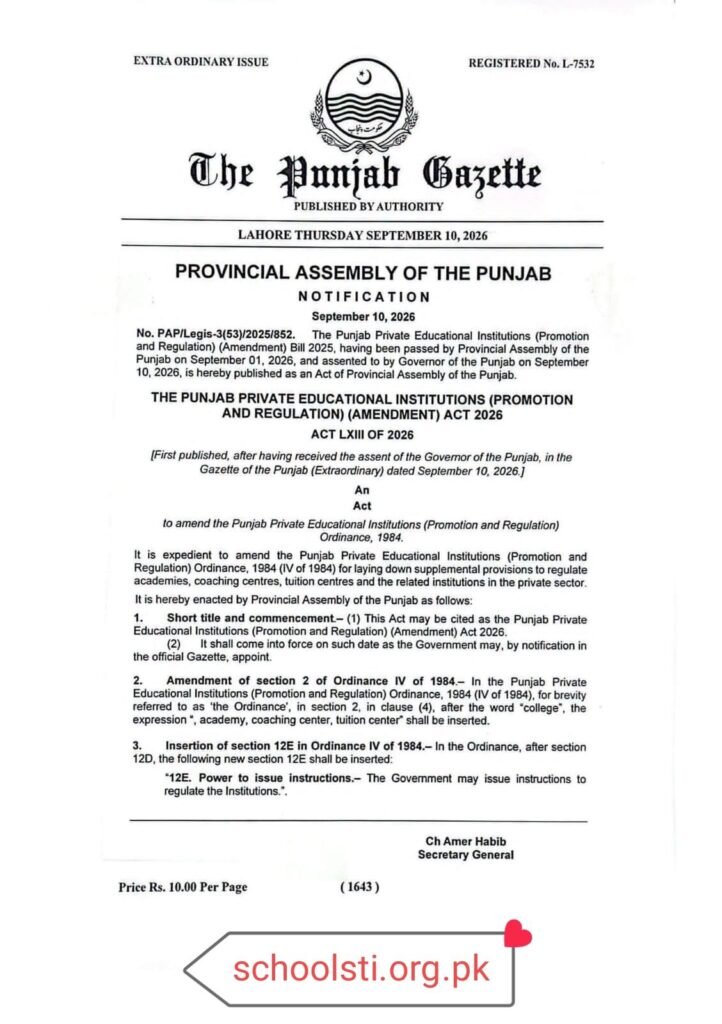
That governance gap has officially closed. On September 10, 2026, the Government of the Punjab officially published The Punjab Private Educational Institutions (Promotion and Regulation) (Amendment) Act 2026 (Act LXIII of 2026) in The Punjab Gazette. Under this landmark legislation, academies, coaching centers, and tuition centers have been formally incorporated into the legal definition of confidential educational institutions across Punjab.
Below is an exhaustive legal, operational, and pedagogical breakdown of the amendment, what it requires from academy operators, how it safeguards parents and students, and its long-term ramifications for the province’s educational ecosystem.
Key Highlights of the Punjab Gazette Notification (Act LXIII of 2026)
The legislative transition originated through The Punjab Private Educational Institutions (Promotion and Regulation) (Amendment) Bill 2025, which was officially passed by the Provincial Assembly of the Punjab on September 01, 2026, and granted formal assent by the Governor of the Punjab on September 10, 2026.
The official notification—issued under No. PAP/Legis-3(53)/2025/852 by Secretary General Ch Amer Habib—amends the foundational Punjab Private Educational Institutions (Promotion and Regulation) Ordinance, 1984 (IV of 1984).
Summary of Legislative Specifics
| Statutory Parameter | Legal Specification |
|---|---|
| Official Act Title | The Punjab Private Educational Institutions (Promotion and Regulation) (Amendment) Act 2026 |
| Act Number | Act LXIII of 2026 |
| Gazette Reference | Registered No. L-7532, Extraordinary Issue, The Punjab Gazette |
| Parent Statute Amended | Punjab Private Educational Institutions (Promotion and Regulation) Ordinance, 1984 (IV of 1984) |
| Assembly Approval Date | September 01, 2026 |
| Governor’s Assent Date | September 10, 2026 |
| Enactment Authority | Provincial Assembly of the Punjab |
| Primary Beneficiaries | Students, parents, instructional staff, and registered educational bodies |
Core Legislative Changes: What Was Added to the Law?
The amendment is concise yet sweeping in its jurisdiction. It introduces two decisive interventions into Ordinance IV of 1984:
1. Expansion of Section 2, Clause (4)
Prior to this enactment, clause (4) of Section 2 primarily designated schools, colleges, and recognized teaching institutes as private educational institutions. The modern amendment formally inserts:
“…academy, coaching center, tuition center…” immediately after the word “college”.
By expanding this statutory definition, every commercial establishment offering curriculum coaching, board exam prep (BISE matric/intermediate), university entrance preparation (such as MDCAT, ECAT, LAT), or competitive exam guidance falls under the statutory net of the Registering Authority and the Punjab School Education Department.
2. Insertion of Section 12E (Power to Issue Instructions)
The Act introduces a broad regulatory provision empowering the provincial executive:
“12E. Power to issue instructions.— The Government may issue instructions to regulate the Institutions.”
This clause gives the provincial authority wide administrative authority to issue binding policy circulars, fee rules, safety protocols, qualification benchmarks, and operational calendars specifically tailored for tuition academies without having to return to the legislature for primary enactments.
Why Academies and Tuition Centers Were Brought Under Government Purview
Over the past two decades, “shadow education” transitioned from an auxiliary service into an expansive, parallel schooling sector. While academies have provided focused test preparation and supplementary academic assist, the lack of administrative oversight created systemic challenges:
- Unstandardized and Opaque Fee Models: Academy charges ranged from modest community fees to exorbitant monthly subscriptions, registration charges, and test-session fees with zero price transparency or refund frameworks.
- Infrastructure Deficits and Safety Hazards: Many commercial tuition setups operate out of converted residential spaces, basements, or congested commercial plazas lacking emergency exits, fire-suppression equipment, structural safety certificates, and adequate ventilation.
- Faculty Discrepancies and Exploitation: Unregistered setups frequently hired instructors without credential verification, written contracts, or fair labor safeguards, creating instability for both educators and students.
- Misleading Advertising: Exaggerated claims regarding board toppers, guaranteed MDCAT admissions, and faculty credentials operated without verification or advertising standards.
By aligning coaching centers with the standards outlined in the Governing Laws of the School Education Department, the province aims to balance commercial tutoring enterprise with consumer protection and pupil safety.
Comparative Matrix: Before vs. After the 2026 Amendment
To grasp the practical impact of Act LXIII of 2026, the table below illustrates the shift in administrative realities:
| Regulatory Area | Before Act LXIII of 2026 | After Act LXIII of 2026 |
|---|---|---|
| Legal Classification | Unregulated commercial / personal service | Recognized Private Educational Institution under Ordinance IV of 1984 |
| Mandatory Registration | Exempt; operated on municipal trade licenses or without formalities | Compulsory registration through District Education Authorities (DEAs) |
| Fee Structure Oversight | Completely autonomous; arbitrary increases | Subject to governmental oversight, transparency rules, and documentation |
| Building & Facility Codes | Minimal to non-existent municipal enforcement | Subject to structural safety, fire safety, and health standards |
| Faculty Safeguards | Informal agreements; no mandatory vetting | Subject to baseline qualification criteria and employment documentation |
| Government Directives | Discretionary compliance | Legally binding compliance under the newly inserted Section 12E |
Regulatory Implications for Academy Owners and Administrators
For academy owners, tuition centers, and coaching franchises across Lahore, Faisalabad, Rawalpindi, Multan, Gujranwala, and beyond, the enactment necessitates immediate operational realignment.
1. Mandatory Institutional Registration
Centers must prepare institutional dossiers for submission to the respective District Registering Authorities. This process requires clear title or lease deeds of premises, floor plans, capacity declarations, and owner identity verifications. For detailed guides on administrative compliance, staying updated via verified Punjab education department updates on anxietyreduce.com/ can help administrative teams organize mandatory documentation.
2. Building Safety, Hygiene, and Space Standards
Inspectors will assess pupil-to-area ratios, emergency evacuation paths, clean drinking water availability, separate sanitary facilities for male and female students, and uninterrupted lighting and ventilation. Basements without secondary fire exits and unventilated mezzanine halls may face immediate operational restrictions.
3. Faculty Profiling and Ethical Marketing
Academies must maintain transparent educator registries, including verified academic credentials and formal hiring contracts. Advertising materials—particularly claims regarding board positions and scholarship allocations—will fall under regulatory scrutiny to deter fraudulent promotions.
4. Financial Records and Tax Conformance
Integrating into the formal confidential educational institution register necessitates streamlined accounting, auditable bank accounts, and documented fee receipts, curbing cash-only off-the-books transactions.
Impact on Students and Parents: A Balance of Quality and Access
The inclusion of academies under statutory regulation directly impacts students and parents:
                      ┌─────────────────────────────────────────┐
                      │    Act LXIII of 2026 (Gazette Assent)   │
                      └────────────────────┬────────────────────┘
                                           │
             ┌─────────────────────────────┴─────────────────────────────┐
             ▼                                                           ▼
┌─────────────────────────┐                                 ┌─────────────────────────┐
│     Parent Benefits     │                                 │   Student Safeguards    │
├─────────────────────────┤                                 ├─────────────────────────┤
│ • Fee transparency      │                                 │ • Verified instructors  │
│ • Clear refund policies │                                 │ • Safe, certified spaces│
│ • Grievance channels    │                                 │ • Sanitized environment │
│ • Validated credentials │                                 │ • Structured curriculum │
└─────────────────────────┘                                 └─────────────────────────┘
- Parental Relief: Parents now have statutory recourse through District Registering Authorities in cases of unauthorized mid-session fee hikes, sudden closures, or misrepresentation.
- Student Well-being: Regulating instructional hours helps prevent excessive academic scheduling where students attend morning school and lengthy evening sessions without standard physical or mental breaks.
Frequently Asked Questions (FAQs)
What is the Punjab Private Educational Institutions (Amendment) Act 2026?
It is a provincial law (Act LXIII of 2026) passed by the Provincial Assembly of the Punjab that formally amends the 1984 Ordinance to include academies, coaching centers, and tuition centers under the definition and regulatory framework of private educational institutions.
Does this amendment apply to individual home tutors?
The primary intent of the Act focuses on commercial institutions, multi-learner academies, test-prep franchises, and dedicated tuition centers. Subsequent procedural rules issued by the Government under Section 12E will further define threshold capacities and categorize commercial tutoring facilities versus independent individual tutoring.
What powers does Section 12E grant to the Punjab Government?
Section 12E grants the Government the broad authority to issue administrative instructions and directives to regulate institutions. This covers operational norms, fee protocols, safety benchmarks, and administrative compliance.
What steps should tuition academy owners take immediately?
Academy administrators should review lease agreements, verify building safety measures, organize instructor qualification portfolios, structure transparent fee schedules, and follow official circulars from the School Education Department. Regularly reviewing verified educational policy analysis on anxietyreduce.com/ can assist administrators in tracking implementation deadlines.
When does the Act come into force?
According to Section 1(2) of the Act, it shall come into force on such date as the Government of the Punjab may appoint by notification in the official Gazette.
Analysis
The passage of Act LXIII of 2026 represents a pragmatic recognition of educational realities in Punjab:
- Closing a 40-Year Regulatory Vacuum: The original 1984 Ordinance was formulated when exclusive education predominantly meant standard primary and secondary schools. The contemporary dominance of entry-test networks and parallel evening coaching made the original framework obsolete.
- Shift Toward Consumer Protection: Tuition fees represent a substantial portion of household income across urban and semi-urban Punjab. Regulating academies introduces financial accountability, verifiable student outcomes, and legal consumer protections.
- Formalization of the Shadow Economy: Transitioning tutoring operations from unregistered entities to formalized educational organizations improves regulatory clarity and institutional accountability.
- Operational Consolidation: Smaller, substandard coaching centers operating in hazardous locations will need to consolidate, upgrade, or face closure, leading to professionalization across the coaching market.
Opinion
The administration’s decision to bring academies, coaching centers, and tuition centers under statutory authority is a constructive and overdue reform. For too long, the distinction between formal schools and supplementary coaching allowed tutoring enterprises to generate commercial revenue while avoiding regulatory and safety responsibilities.
Nonetheless, the ultimate success of Act LXIII of 2026 hinges on fair and transparent execution:
- Avoiding Bureaucratic Rent-Seeking: District Education Authorities must implement streamlined, digital, single-window registration workflows. If the process becomes cumbersome, it risks encouraging informal arrangements rather than compliance.
- Proportionate Tiering: A neighborhood coaching center charging nominal fees should not face identical administrative demands as a multi-campus, high-fee entry-test commercial franchise. Regulations introduced under Section 12E must account for scale and socioeconomic differences.
- Addressing Systemic Causes: While regulating coaching centers is essential, policymakers must recognize that the reliance on evening academies reflects persistent curriculum and instructional gaps in mainstream morning schooling. Correct educational stability requires strengthening classroom instruction alongside regulatory oversight.
Conclusion
The Punjab Private Educational Institutions (Promotion and Regulation) (Amendment) Act 2026 marks a decisive turning point for supplementary education across the province. By incorporating academies, coaching centers, and tuition centers into the formal legal framework, the provincial authority has established the foundation for improved accountability, physical safety, and fee transparency.
Stakeholders—from large coaching franchises to community tuition centers—should proactively review their compliance readiness, infrastructure standards, and academic practices to align with the evolving regulatory standards of Punjab’s educational landscape.
اب اکیڈمیز، کوچنگ سینٹرز اور ٹیوشن سینٹرز بھی پنجاب پرائیویٹ ایجوکیشنل انسٹی ٹیوشنز (پروموشن اینڈ ریگولیشن) ایکٹ 2026 کے دائرۂ کار میں آئیں گے۔ ترمیم کے ذریعے نجی تعلیمی اداروں کی تعریف میں باقاعدہ طور پر Academy, Coaching Centre اور Tuition Centre کو شامل کر دیا گیا ہے۔