Punjab School Education Department Mandates Daily Quick Tests and Monthly Assessments: Complete Notification Analysis and Implementation Guide
The School Education Department (SED), Government of the Punjab, has issued a pivotal policy directive aimed at tracking and accelerating pupil learning outcomes across all public sector schools. Under official notification No. DG(M&E)/MISC/2026, dated September 22, 2026, the Directorate General of Monitoring & Evaluation (M&E) has instructed all Chief Executive Officers of District Education Authorities (CEOs – DEAs) to enforce mandatory 10-minute daily prompt tests, structured monthly assessments, and centralized digital data recording.
This policy marks a transition toward continuous formative evaluation and data-backed accountability across Punjab’s primary, elementary, secondary, and higher secondary schools. Below is an exhaustive breakdown of the official directive, actionable classroom frameworks, administrative workflows, and an analytical assessment of what this initiative means for teachers, headmasters, and administrative inspection teams.
Key Highlights of Notification No. DG(M&E)/MISC/2026
Issued from the Punjab School Education Department’s headquarters at 11-A Lawrence Road, Lahore, under the signature of Rana Abdul Qayyum Khan, Director General (Monitoring and Evaluation), the order mandates uniform compliance across every district.
┌────────────────────────────────────────────────────────────────────────────┐
│                    SED PUNJAB ASSESSMENT NOTIFICATION AT A GLANCE           │
├──────────────────────┬─────────────────────────────────────────────────────┤
│ Issuing Authority    │ Directorate General (Monitoring & Evaluation), SED   │
│ Notification Date    │ September 22, 2026                                  │
│ Target Beneficiaries │ Students across all Public Schools in Punjab        │
│ Primary Mechanisms   │ 10-Min Daily Tests, Monthly Tests, Register Records │
│ Digital Platform     │ Centralized Portal Database / SIS Integration       │
│ Regulatory Support   │ PECTAA & Directorate of Public Instruction (SE/EE)  │
│ High-Level Scrutiny  │ Direct inspection by Secretary School Education      │
└──────────────────────┴─────────────────────────────────────────────────────┘
The document has been officially circulated to key administrative stakeholders, including the Chief Executive Officer of the Punjab Education Curriculum Training and Assessment Authority, the Directors of Public Instruction (DPI) for Secondary and Elementary Education (both Central Punjab and South Punjab), and the personal staff of the Worthy Secretary of School Education.
Core Pillars of the SED Assessment Directives
The reform rests upon four distinct operational requirements designed to eliminate blind spots in academic progress.
                         ┌─────────────────────────────────┐
                         │   SED 4-Pillar Evaluation Model  │
                         └────────────────┬────────────────┘
                                          │
        ┌───────────────────┬─────────────┴─────────────┬───────────────────┐
        ▼                   ▼                           ▼                   ▼
┌───────────────┐   ┌───────────────┐           ┌───────────────┐   ┌───────────────┐
│ Daily 10-Min  │   │ Comprehensive │           │ Student-Wise  │   │ Centralized   │
│  Quick Tests  │   │ Monthly Tests │           │ Paper Records │   │ Digital Sync  │
└───────────────┘   └───────────────┘           └───────────────┘   └───────────────┘
1. Daily 10-Minute Quick Tests (Formative Evaluation)
Teachers across all grade levels and disciplines must set aside the final 10 minutes of their instructional periods to administer a quick assessment. The objective is to:
- Gauge genuine-time comprehension of the specific concepts delivered during that day’s lesson.
- Discourage passive rote learning by identifying misunderstandings immediately.
- Provide teachers with actual-moment feedback to adjust their next day’s instructional plan.
2. Comprehensive Monthly Assessments (Diagnostic Tracking)
At the conclude of each academic period of weeks, schools must conduct structured, subject-wise monthly examinations. Unlike casual class tests, these assessments:
- Cover the entirety of the monthly syllabus distribution.
- Diagnose pupil learning gaps (SLGs) and areas requiring remediation.
- Measure retention over broader cognitive units.
3. Dedicated Student-Wise Performance Registers
Every classroom or subject educator must maintain an official Student Performance Register.
- Individual marks scored in every monthly test must be systematically recorded.
- The register must remain updated, no-cost from discrepancies, and organized by pupil roll number.
- These physical registers are mandatory review documents during official supervisory inspections.
4. Digital Integration via Portal Database and SIS
The directive stipulates that physical logs alone are insufficient. Institution heads are personally tasked with entering:
- Monthly test scores across each subject.
- School Based Assessment (SBA) term scores and annual assessment metrics.
- Cumulative student scores uploaded to the SED SIS Portal for longitudinal learner-degree tracking.
The Punjab Education Curriculum Training and Assessment Authority (PECTAA) has been assigned the mandate to furnish technical guidelines, standardized rubrics, and automated item banks to ensure standardisation across districts.
Structural Comparison: Daily Tests vs. Monthly Assessments vs. SBA
To avoid operational ambiguity in academy administration, the table below delineates the functional differences between the three distinct assessment layers now operating in Punjab open schools:
| Parameter | 10-Minute Daily Quick Test | Comprehensive Monthly Assessment | School Based Assessment (SBA) |
|---|---|---|---|
| Primary Objective | Formative check on daily classroom learning outcomes | Summative & diagnostic progress check over monthly units | High-stakes standardized term and annual evaluation |
| Frequency | Daily (finish of each instructional period) | Once per period of weeks per subject | Term-wise (Mid-Term / Final / Annual rounds) |
| Assessment Medium | Notebook slips, whiteboards, or oral/written prompts | Formal query sheets / solution sheets | PECTAA centralized item-bank generated papers |
| Record Keeping | Teacher diary / speedy grade ledger | Physical Student Performance Register | Centralized digital database & learner report cards |
| Supervisory Focus | AEO classroom observation & active teaching checks | DEA / CEO / DGM&E inspection checklists | Provincial reporting & pupil promotion criteria |
| Digital Entry | Not required online (internal feedback) | Mandatory on the designated SED portal | Mandatory on portal / SIS with printable cards |
For practical record templates and automated register formats, educators can review updated Punjab teachers assessment resources designed for field implementation.
Inspection and Verification Protocol
Paragraph 3 of the notification highlights an uncompromising oversight mechanism. Assessment registers will not merely be audited by Assistant Education Officers (AEOs) or Monitoring and Evaluation Assistants (MEAs); they are now an explicit focus of senior leadership visits.
┌────────────────────────────────────────────────────────────────────────┐
│                   INSPECTION AND AUDIT CHAIN OF COMMAND                │
├────────────────────────────────────────────────────────────────────────┤
│  Worthy Secretary, SED (High-level on-ground inspections)              │
│       ▲                                                                │
│  Director General (M&E) & Provincial DPIs (Oversight & Monitoring)    │
│       ▲                                                                │
│  Chief Executive Officers (CEOs - DEAs) (District-stage enforcement)   │
│       ▲                                                                │
│  DEOs / Dy. DEOs / AEOs (Cluster audits and classroom verification)    │
│       ▲                                                                │
│  Head of Institution (Record maintenance & portal synchronization)     │
└────────────────────────────────────────────────────────────────────────┘
When the Worthy Secretary, School Education Department, visits any school across the province, the verification protocol includes:
- Direct Register Inspection: Random verification of physical registers against actual pupil roll lists.
- Classroom Spot Checks: Cross-verifying a student’s registered marks with an on-the-spot conceptual check.
- Portal Reconciliations: Auditing online submissions against hardcopy test sheets to prevent data fabrication.
Classroom Implementation Guide for Headteachers and Educators
To execute this directive without causing administrative friction or instructional loss, schools should adopt a structured weekly schedule.
Standardized Format for the Student Assessment Register
School heads should ensure their registers contain the following columns per subject:
┌──────┬──────────────┬──────────────┬──────────────┬─────────────┬─────────────┬──────────────┐
│ Roll │ Student Name │ Monthly Test │ Subject-Wise │  Total Mark │ Portal Sync │ Remedial Plan│
│  No. │              │  (MM: 25/50) │ Breakdown    │  Percentage │ Status (Y/N)│ Assigned     │
└──────┴──────────────┴──────────────┴──────────────┴─────────────┴─────────────┴──────────────┘
Actionable Steps for Classroom Teachers
- Timeboxing Instructional Periods: In a standard 40-to-45-minute period, allocate 5 minutes to revision, 25 to 30 minutes to core pedagogy, and reserve the final 10 minutes exclusively for the prompt test.
- Utilizing Low-Cost Formative Tools: Utilize exit tickets, 3-query conceptual quizzes (one Knowledge-based, one Understanding-based, one Application-based), or short objective prompts.
- Targeted Remediation: Use monthly assessment scores to cluster students into remedial groups rather than treating marks as mere record-keeping.
For supplementary administrative guidance and circular archives, consult recent school education notifications and updates.
Global Alignment: Formative Assessment Best Practices
The introduction of daily formative assessment brings Punjab’s open education closer to evidence-backed international models. According to benchmark frameworks published by the UNESCO International Institute for Educational Planning, continuous classroom-based micro-testing provides higher gains in pupil learning outcomes (SLOs) compared to infrequent, high-stakes testing alone.
Furthermore, empirical education research on foundational learning reveals:
- The Retrieval Effect: Retrieving information during a daily 10-minute test reinforces neural retention far more effectively than passive re-reading.
- Early Deficit Discovery: Monthly diagnostics prevent learning deficits from compounding unnoticed until annual exams.
- Data-Driven Interventions: Centralized pupil tracking allows the Punjab School Education Department to allocate academic mentors and remedial programs precisely to underperforming schools.
Frequently Asked Questions (FAQs)
What is the exact purpose of the 10-minute Daily Quick Test?
The daily fast test is a formative assessment tool designed to assess whether students understood the exact learning concepts taught in that day’s lecture. It highlights immediate comprehension hurdles before fresh material is introduced.
Are daily speedy test marks entered into the online SIS portal?
No. Daily quick tests are classroom-level pedagogical tools. Only monthly comprehensive assessment scores and School Based Assessment (SBA) marks must be formally recorded in physical registers and entered into the central portal database.
Who is responsible for uploading monthly assessment data to the portal?
The head of the institution (Headmaster/Headmistress/Principal) bears primary administrative responsibility for ensuring that subject teachers evaluate answer books, enter marks into physical registers, and upload the scores onto the portal database.
What happens if an institution fails to produce registers during official visits?
As stated in the directive signed by DG (M&E) Rana Abdul Qayyum Khan, inspection teams, including the Secretary of School Education, will review these records. Non-compliance, incomplete records, or falsification of data can lead to disciplinary proceedings under PEEDA laws for supervisory negligence.
Analysis: Key Takeaways
- Shift to Formative Evaluation: The notification represents a obvious shift away from purely rote, annual examination systems toward continuous formative monitoring.
- Systemic Data Accountability: Linking physical registers with central database entry prevents ghost attendance and unverified academic claims, providing provincial planners with reliable metrics.
- Curricular Alignment: With PECTAA overseeing support and assessment standards, tests will increasingly reflect Student Learning Outcomes (SLOs) rather than textbook memorization.
- Heightened Headteacher Responsibility: School heads serve as the operational focal point; failure to maintain updated records directly exposes administrative personnel to supervisory scrutiny during executive tours.
Opinion: Expert Educational Verdict
The Punjab School Education Department’s notification on daily and monthly testing is conceptually sound and pedagogically necessary. In a school system grappling with post-primary dropout rates and foundational literacy and numeracy gaps, continuous micro-evaluations are an effective application to restore academic discipline.
Nonetheless, the policy’s real-planet impact hinges entirely on implementation without administrative fatigue. Communal school educators in Punjab frequently face non-teaching duties, multi-grade classrooms, and adverse pupil-educator ratios. If these daily 10-minute tests and monthly registers become purely mechanical record-keeping chores designed to appease visiting inspectors, the correct formative purpose will be lost.
To create this reform successful:
- PECTAA must supply pre-calibrated item banks: Providing teachers with ready-to-utilize, SLO-aligned quick-test prompts will drastically reduce daily preparation burdens.
- The online portal interface must be streamlined: Data entry must be fast, mobile-responsive, and accessible to prevent administrative task from encroaching on valuable teaching hours.
- Inspections must back rather than penalize: Supervisory teams should treat assessment registers as diagnostic health charts for pedagogical counseling, rather than tools for punitive action.
If executed with balanced institutional help, this initiative could establish the foundational data architecture required to meaningfully elevate educational grade across Punjab’s open schools.

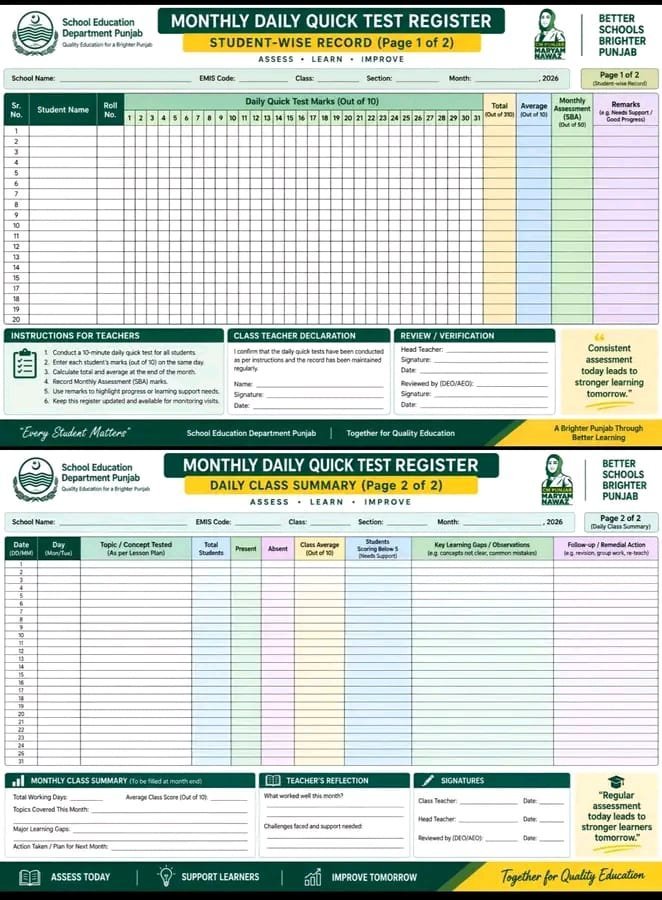
Download pdf file daily test record school education department register 2026