Punjab School Education Department Opens E-Transfers 2026 Under Hardship Category: Complete Schedule, Eligibility, and Application Guide
The Government of the Punjab School Education Department (SED) has officially notified the opening of e-Transfers under the Hardship Category for 2026. Issued via Notification No. SO(SE-F)Misc-2/2026 on September 23, 2026, by the Section Officer (Secondary Education – Female), the directive operationalizes clause 10.3(vii) of the amended e-Transfer Policy, 2024.
For thousands of communal academy educators across the province facing acute personal, medical, or domestic constraints, this notification provides a transparent, digitized mechanism to request reassignment. Hardship transfer orders will now be managed continuously via the School Information System (SIS) portal, eliminating manual discretion and ensuring direct administrative oversight.
Key Highlights of the Hardship E-Transfer Notification 2026
The notification directs the Chief Executive Officer of the Punjab Education Curriculum Training and Assessment Authority (PECTAA) and all Chief Executive Officers of District Education Authorities (CEOs DEAs) across Punjab to enforce the following procedural framework:
- Official Notification Number: SO(SE-F)Misc-2/2026
- Issuing Authority: School Education Department, Government of the Punjab
- Date of Issuance: September 23, 2026
- Online Application Window: September 28, 2026 – October 08, 2026
- Platform: Punjab SIS Portal / SEDHR Application
- QR-Coded Transfer Orders: November 29, 2026 – November 30, 2026
- Year-Round Processing: Continuous processing of hardship grounds through the SIS architecture
Educators seeking verified circulars, merit lists, and step-by-step documentation guides can consult the School STI education portal for real-duration district-wise updates.
Eligible Hardship Categories Under e-Transfer Policy 2024
Under clause 10.3(vii) of the amended e-Transfer Policy, eligibility is restricted to strictly verifiable humanitarian and domestic conditions. Applications submitted outside these defined parameters are rejected at the preliminary scrutiny standard.
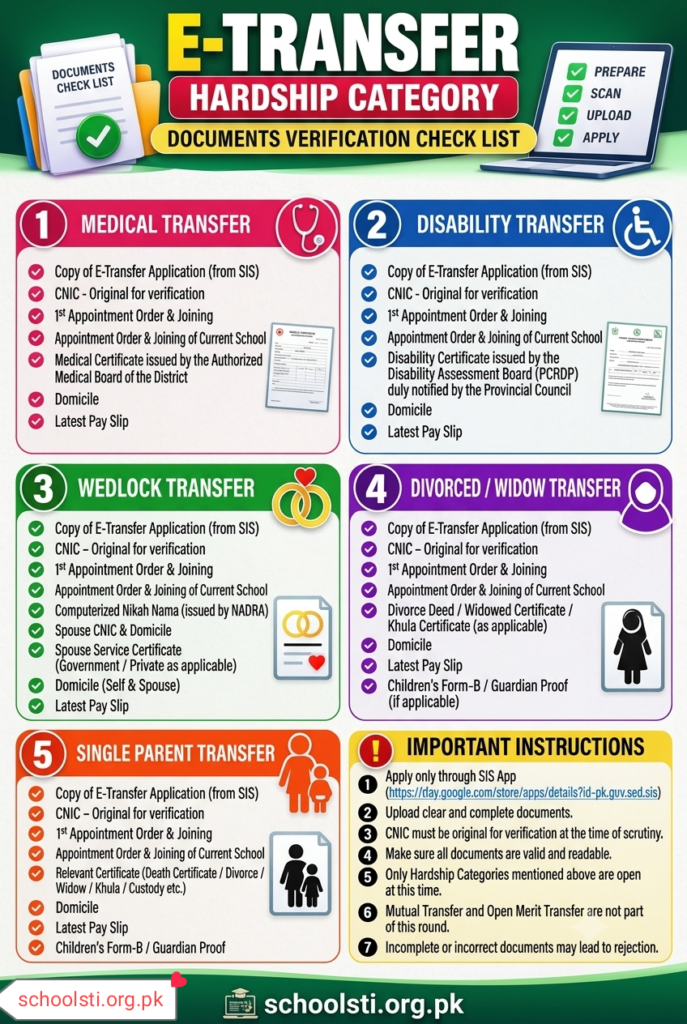
1. Divorced, Widow, and Khula Grounds
- Divorce / Khula: Female educators who have obtained an official divorce or Khula decree from a family court or registered union council can apply for posting near their parental home or primary site of residence.
- Widow Status: Female teachers who have lost their spouse are eligible upon submission of an official death certificate issued by NADRA.
2. Differently Abled (Disability Grounds)
Teachers possessing a authority-recognized disability certificate issued by the Provincial or District Assessment Board can apply for postings at accessible institutions close to their permanent address.
3. Serious Medical Grounds
This subcategory addresses chronic, debilitating, or existence-threatening medical conditions affecting the educator, their spouse, or dependent children (e.g., cancer, dialysis-dependent renal disease, cardiac complications, or major physical incapacitation). Supporting records must comprise validation from an authorized District or Special Medical Board.
4. Wedlock Policy
Under the provincial wedlock framework, married educators can request placement in the same district, tehsil, or station where their spouse is employed in a public sector department, autonomous body, or armed forces.
5. Circumstantial Single Parent
Educators bearing sole custodial responsibility for minor children due to extreme domestic circumstances, incapacitation of a partner, or legal separation without formal help can apply under this window.
6. Transfer of Female Teachers Upon Marriage
Female educators married after their initial recruitment or posting can apply to relocate to their husband’s permanent place of residence or workplace upon presenting a valid NADRA Marriage Registration Certificate (Nikahnama/Computerized Marriage Certificate).
Official Schedule and Timeline for Hardship E-Transfers 2026
The department has established a strict phase-wise calendar. Missing any stage forfeits the right to appeal or consideration during this transfer phase.
| Phase / Action Item | Responsible Forum | Start Date | End Date |
|---|---|---|---|
| Submission of Online Applications | Applicant Teachers via SIS Portal | 28.09.2026 | 08.10.2026 |
| Scrutiny & Recommendations | District Hardship Committee (DHC) | 10.10.2026 | 16.10.2026 |
| Filing of Representations against DHC | Aggrieved Teachers before DGRC | 18.10.2026 | 03.11.2026 |
| Processing of Representations | Divisional Grievances Redressal Committee (DGRC) | 04.11.2026 | 20.11.2026 |
| Final Review of Recommendations | Departmental Hardship Committee (Apex Level) | 21.11.2026 | 27.11.2026 |
| Issuance of QR-Coded Transfer Orders | SED via SIS Portal | 29.11.2026 | 30.11.2026 |
| Statutory Appellate Window | Special Secretary (Operations), SED | Within 7 days of order issuance |
Step-by-Step Application Process on the SIS Portal
To maintain data integrity and prevent unauthorized modifications, all submissions must originate from the applicant’s registered credentials on the centralized portal hosted by the Punjab Information Technology Board (PITB).
- Access the Portal: Log in to the official SIS / SEDHR mobile application or web portal using your personal CNIC and password.
- Select Transfer Type: Navigate to the Transfer module and select Hardship Category (Policy 2024).
- Choose the Relevant Subcategory: Identify your applicable ground (e.g., Wedlock, Medical, Disability, Widow/Divorce, Marriage).
- Target School Selection: Select vacant posts matching your specific designation and subject cadre. Verify that the Student-Teacher Ratio (STR) permits outward and inward mobility.
- Document Upload: Attach legible, high-resolution scans of mandatory proofs (e.g., NADRA certificates, Medical Board reports, service cards, or nikahnama). Incomplete uploads lead to immediate rejection during DHC verification.
- Final Submission: Review the application summary and confirm submission before 23:59 hours on October 08, 2026. Retain the computer-generated tracking number for subsequent committee hearings.
For an indexed checklist of required annexures and district verification protocols, review the School STI policy resources.
Grievance Redressal and Multi-Tier Appeal Mechanism
To safeguard against arbitrary administrative rejections, the School Education Department provides a three-tiered redressal architecture:
[District Hardship Committee (DHC)]
           │
           ▼ (Rejection / Non-recommendation)
[Divisional Grievances Redressal Committee (DGRC)]
           │
           ▼
[Departmental Hardship Committee (Apex Level)]
           │
           ▼ (Issuance of QR Orders: Nov 29-30, 2026)
[Appellate Authority: Special Secretary (Operations)]
- Tier 1 — District Hardship Committee (DHC): Scrutinizes primary physical records against digital uploads between October 10 and October 16, 2026.
- Tier 2 — Divisional Grievances Redressal Committee (DGRC): Teachers whose requests are declined or marked defective by the DHC can submit a formal representation between October 18 and November 03, 2026. The DGRC conducts hearings and disposals through November 20, 2026.
- Tier 3 — Departmental Hardship Committee: The apex provincial forum reviews all consolidated submissions from November 21 to November 27, 2026, before sanctioning final transfers.
- Statutory Appeal: If an applicant remains aggrieved following final orders, paragraph 2 of the notification guarantees the statutory right to appeal directly before the Special Secretary (Operations) at the Punjab School Education Department within seven (7) days of order issuance.
Comparative Assessment: Hardship vs. Broad Open-Merit E-Transfers
| Feature / Metric | General / Open Merit e-Transfers | Hardship Category e-Transfers |
|---|---|---|
| Primary Basis | Seniority score, distance calculation, qualification | Human welfare, medical severity, family cohesion |
| Operational Cadence | Bi-annual or scheduled periodic rounds | Scheduled rounds plus twelve months-round SIS availability |
| Documentation Level | Standard service records on SIS | Specialized third-party verification (Medical/NADRA/Court) |
| Review Authority | Automated algorithmic merit calculation | Multi-tier administrative committees (DHC, DGRC, Apex) |
| Applicability to STR | Strictly constrained by institution capping rules | Evaluated on merit with humanitarian exemptions where permitted |
Frequently Asked Questions (FAQs)
What is the deadline to submit the online hardship transfer application?
The online submission window opens on September 28, 2026, and closes on October 08, 2026, via the SIS portal.
Are manual or hand-written applications accepted by CEOs?
No. Under the amended e-Transfer Policy 2024, no manual application is entertained. Every application must be logged digitally through the SIS portal.
How will transfer orders be authenticated?
All transfer and posting orders issued between November 29 and November 30, 2026, will trait system-generated QR codes to eliminate forgery and unauthorized postings.
What should a teacher do if the District Hardship Committee rejects their case?
Aggrieved teachers can file a formal representation before the Divisional Grievances Redressal Committee (DGRC) from October 18 to November 03, 2026.
Can an appeal be filed after the issuance of final orders?
Yes. Teachers may file an appeal before the Special Secretary (Operations), School Education Department, within seven (7) days of the issuance of transfer orders.
Analysis: Key Takeaways of the 2026 Hardship Schedule
- Institutionalization of Year-Round Processing: The circular explicitly confirms that hardship transfers will operate continuously through the SIS architecture, transitioning away from disruptive, sporadic manual interventions.
- Definite Accountability Windows: Each administrative tier—from the district stage (DHC) to the divisional tier (DGRC)—is bound by explicit, non-overlapping dates, minimizing prolonged bureaucratic delays.
- Enhanced Fraud Deterrence: Requiring verified QR-coded orders curbs unauthorized relieving and joining practices, ensuring actual-time reconciliation with provincial human resource databases.
Opinion: Expert Administrative Verdict
The School Education Department’s prompt release of the hardship calendar demonstrates a continued commitment to institutional transparency and digitized governance. By embedding precise protections for widowed, differently abled, divorced, and medically compromised educators directly into the SIS workflow, the department addresses valid welfare requirements while safeguarding instructional continuity in classrooms.
However, the efficacy of this policy hinges entirely on objective scrutiny by District Hardship Committees. District education authorities must maintain strict impartiality, adhere scrupulously to verification protocols, and respect the statutory deadlines. For educators, submitting authentic, unadulterated documentation during the initial application window remains critical to preventing procedural rejections.

Opening of E-Transfer Hardship roundہارڈشپ کیٹیگری کے تحت ای ٹرانسفر کھولنے کا نوٹیفکیشن جاری
⬅️ محکمہ سکول ایجوکیشن پنجاب نے ہارڈشپ کیٹیگری کے تحت E-Transfer کھولنے کی منظوری دے دی ہے۔
ہارڈشپ کیٹیگری میں درج ذیل کیسز شامل ہیں👇
1️⃣ طلاق یافتہ / بیوہ / خلع
2️⃣ معذور اساتذہ
3️⃣ میڈیکل بنیاد
4️⃣ ویڈ لاک
5️⃣ حالات و واقعات کی بنیاد پر سنگل والدین
شادی کی بنیاد پر خاتون ٹیچر کا تبادلہاہم شیڈول آن لائن درخواستیں SIS کے ذریعے 28 ستمبر 202 تا 8 اکتوبر 2026
Hardship e transfer documents check list 2026