Sample E-Sheets by BISE Lahore: Complete Guide to the New On-Screen Marking System for Chemistry, Biology, and Computer Science
The Board of Intermediate and Secondary Education (BISE) Lahore has officially initiated a major digital transition in its examination assessment model: the rollout of On-Screen Marking (OSM) E-Sheets for Matriculation (SSC) and Intermediate (HSSC) board examinations. Initially deployed for core scientific disciplines—specifically Chemistry, Biology, and Computer Science (کیمسٹری ،بائیولوجی اور کمپیوٹر سائنس کے پیپرز ان شیٹس پر لیے جائیں گے)—this digital evaluation framework replaces traditional subjective response booklets with structured, barcode-indexed, scanned response sheets.
For students, educators, and institutions throughout Punjab, this transition fundamentally alters how papers are attempted, scanned, and evaluated. Writing outside the allotted lines, misfilling roll number bubbles, or using unapproved stationery can now result in immediate paper invalidation.
What Are BISE Lahore E-Sheets?
A BISE Lahore E-Sheet is a standardized, machine-readable solution booklet designed specifically for high-speed optical scanning and digitized on-screen evaluation. Unlike conventional solution scripts—where candidates manually drew margins, assigned arbitrary page lengths to answers, and attached multiple supplementary continuation sheets—an E-Sheet provides pre-allocated, bounded writing zones for each designated question part.
Once examinations conclude, physical sheets are transported to centralized high-security scanning hubs set up by the Board of Intermediate and Secondary Education, Lahore. High-speed duplex scanners digitize every page, and the software segments candidate responses inquiry-by-inquiry, routing them anonymously to authorized sub-examiners across Punjab for rubric-based on-screen scoring.
Official Sample Sheet Specifications at a Glance
| Feature / Element | Technical Specification | Operational Purpose |
|---|---|---|
| Corner Alignment Crosshairs (+) | 4-point fiducial marks on all corners | Calibrates scanner optics to prevent skew and text truncation |
| Indexing Barcode & QR Codes | Dual foremost-header codes with 9-digit serial (e.g., 242720001) | Anonymizes student identity and links cropped question boxes to examiner dashboards |
| Page 01 Architecture | Dual OMR grid (Roll Number & Paper Code) + Bio-data block | Automates demographic capture and objective paper mapping |
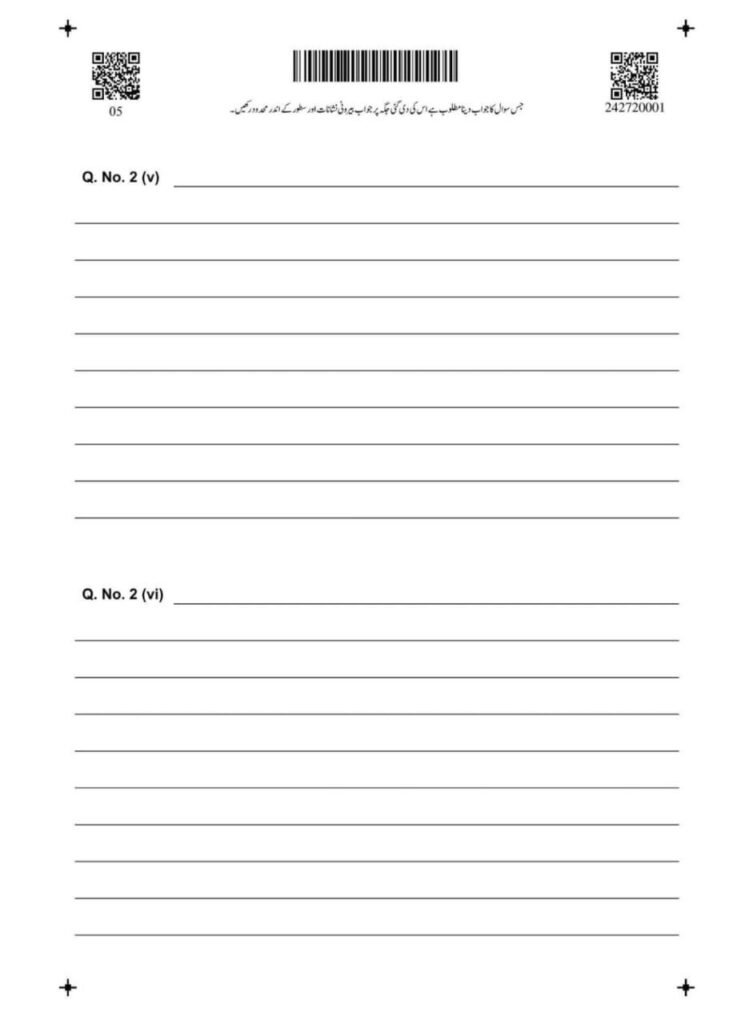
| Pages 03, 04, 05 (Section I) | Two bounded sub-questions per page (approx. 8–9 lines each) | Restricts answers to precise query slots (e.g., Q.2 (i) to Q.2 (vi)) |
| Stationery Compliance | Blue or black ballpoint pen / marker only | Guarantees high optical density for digital scanning contrast |
| Continuation Sheet Policy | Strictly prohibited (Zero extra sheets) | Eliminates misplaced inserts and standardizes response length |
Anatomy of the BISE Lahore E-Sheet: Step-by-Step Breakdown
Careful analysis of the official sample e-sheet released by BISE Lahore reveals three distinct functional layers: demographic capture, question-precise bounded sections, and optical tracking.
+-----------------------------------------------------------------------+
|  [QR] Page 01                  ||||||||||||||| Barcode        [QR] ID |
|               BOARD OF INTERMEDIATE & SECONDARY EDUCATION, LAHORE     |
|                              COMPUTER SCIENCE                         |
|  +-------------------+  +--------------+  +------------------------+  |
|  | Exam Metadata     |  | Roll No Grid |  | Official Instructions  |  |
|  | - Date (DDMMYYYY) |  | (6 Digits)   |  | - Blue/Black pen only  |  |
|  | - Matric / Inter  |  |              |  | - Fill bubbles fully   |  |
|  | - Part 1 / Part 2 |  | Paper Code   |  | - No folding / cutting |  |
|  | - Annual / Supply |  | (4 Digits)   |  | - No unnecessary marks |  |
|  | - Morning/Evening |  |              |  |                        |  |
|  +-------------------+  +--------------+  +------------------------+  |
|  Candidate Credentials: Name, Father's Name, Roll No in Words, Sign   |
+-----------------------------------------------------------------------+
1. Page 01: OMR Header and Candidate Credentials
The cover page functions as an Optical Mark Recognition (OMR) document divided into four crucial quadrants:
- Examination Metadata Matrix (Left Sidebar): Bubble columns indicating academic degree (
Matric/Inter), twelve months part (Part 1/Part 2), session (Annual/Supply), and shift (Morning/Evening). - Numerical Bubble Grids (Center Column): A 6-digit vertical bubble grid for the candidate’s Roll Number and a 4-digit grid for the Paper Code. Both grids demand entering the digit in foremost numerical boxes followed by shading the corresponding bubble below (
0through9). - Urdu and English Mandatory Directives: Explicit warnings stating that partial shading, crosses, tick marks, cutting, or multiple bubble fills render the reply or credential invalid.
- Candidate Signature & Verification Block: Designated fields for candidate name, father’s name, roll number written in words, pupil signature, and deputy superintendent attestation.
2. Pages 03 to 05: Section I (Short Questions Bounded Architecture)
From Page 03 onward, the booklet transitions into Section I (مختصر سوالات):
- Pre-Printed Sub-Question Headings: Each page features exactly two pre-labeled inquiry slots—Page 03 hosts
Q. No. 2 (i)andQ. No. 2 (ii), Page 04 hostsQ. No. 2 (iii)andQ. No. 2 (iv), and Page 05 hostsQ. No. 2 (v)andQ. No. 2 (vi). - Strict Space Boundaries: Every sub-query is allocated approximately 8 to 9 horizontal ruled lines.
- Direct Urdu Injunction: جس سوال کا جواب دینا مطلوب ہے اس کی دی گئی جگہ پر جواب بیرونی نشانات اور سطور کے اندر محدود رکھیں۔ (Keep your solution strictly within the allocated lines and boundary markers for that specific question).
Why Chemistry, Biology, and Computer Science First?
The Punjab educational boards, acting through the Punjab Boards Committee of Chairmen (PBCC), have strategically targeted scientific subjects for the initial phase of E-Sheet adoption. Practical insights and official circulars on the transition are regularly archived on educational reporting platforms such as Schools STI educational updates.
                 Phase 1 Science Pilot Implementation

   [ Chemistry ]                [ Biology ]             [ Computer Science ]
         |                           |                           |
  - Chemical Equations        - Labeled Diagrams          - Syntax Blocks
  - Stoichiometry             - Anatomical Pathways       - Algorithm Steps
  - Structural Formulas       - Genetic Crosses           - Logic Gates
         \                           |                          /
          +--------------------------+-------------------------+
                                     |
                       Direct Precision Evaluation
                       - Eliminates page padding
                       - Standardizes diagram space
                       - Enables targeted inquiry grading
Scientific papers rely on objective, structured answers:
- Chemistry: Conceptual definitions, balanced chemical equations, and short stoichiometry derivations fit naturally within 4 to 8 lines.
- Biology: Concise morphological definitions, labeled physiological flowcharts, and comparison points need direct focus rather than extensive narrative filler.
- Computer Science: Programming syntax, algorithmic logic, flowchart symbols, and architectural definitions demand compact precision.
Evaluating these subjects digitally allows the board to establish clear grading rubrics and test scanner OCR performance before expanding to humanities subjects, mirroring successful models like the FBISE On-Screen Marking System.
Comparison: Traditional Board Answer Sheet vs. BISE Lahore E-Sheet
| Evaluation Parameter | Traditional BISE Answer Booklet | New BISE Lahore E-Sheet (On-Screen Marking) |
|---|---|---|
| Writing Space Allocation | Open-ended blank booklet; learner creates custom headings | Fixed, pre-printed slots with allocated lines per inquiry |
| Supplementary / Extra Sheets | Allowed (students frequently attached “B” and “C” sheets) | Strictly prohibited; zero extra sheets permitted |
| Script Handling & Security | Physical bundles shipped to individual examiner residences | Sealed scripts scanned centrally; anonymous digital evaluation |
| Question Sequencing | Students answered questions in any random order | Answers must appear in designated, pre-printed inquiry slots |
| Candidate Anonymity | Paper slips taped over roll numbers (frequently compromised) | Automated QR code and barcode indexing (examiner sees zero personal data) |
| Evaluation Method | Single examiner marked the entire physical booklet | Different examiners can grade individual cropped questions simultaneously |
| Result Compilation Time | Manual tallying taking 60 to 90 days post-exam | Automated score aggregation reducing consequence compilation cycles |
Critical Dos and Don’ts for Attempting Papers on E-Sheets
Navigating an E-Sheet requires strict adherence to examination protocol. A minor technical mistake on the cover sheet or within answer boundaries can disrupt automated scanning:
Critical Dos
- Shade bubbles completely: Use a high-density blue or black ballpoint pen to fill bubbles entirely, ensuring no white space remains inside the perimeter.
- Match question numbers precisely: Confirm that your response directly answers the exact sub-query printed above the box (e.g., draft the solution for Part
(iii)strictly inside theQ. No. 2 (iii)boundary). - Plan your reply before writing: Because lines are limited to 8–9 per short inquiry, formulate key definitions, formulas, or bullet points mentally before putting pen to paper.
- Keep margins apparent: Ensure diagrams, chemical reactions, or code blocks stay completely within the horizontal lines and do not touch the vertical borders or outer corner crosshairs.
Critical Don’ts
- Never use gel pens or fountain ink: Water-based fountain inks and gel pens bleed through paper fibers, creating ghost marks on duplex scans that can invalidate answers on the reverse page.
- Never fold, staple, or tear edges: Damaging page corners or folding sheets impairs scanner feeder trays and cuts off alignment crosshairs.
- Never draft identity markers: Writing names, mobile numbers, religious phrases, or personal appeals inside answer boxes triggers automatic review by unfair means committees.
- Never attempt questions out of their assigned box: If you draft the response to
Q. No. 2 (i)insideQ. No. 2 (ii), the digital platform crops and sends that snippet to the examiner grading inquiry 2(ii), resulting in zero marks for both parts.
Frequently Asked Questions (FAQs)
What happens if a pupil runs out of lines for a short inquiry on the E-Sheet?
No supplementary sheets or extra lines are provided. Examiners evaluate only what is written within the pre-allocated lines. Students must practice drafting concise, to-the-point answers that fit comfortably within the 8–9 lines provided.
Can students cross out an solution and rewrite it elsewhere on the E-Sheet?
No. Because each query has a dedicated, pre-labeled box, you cannot move a query’s response to another page. If you build a mistake, draw a single neat horizontal strike-through and draft the corrected text within the remaining obtainable lines of that equivalent box.
Which pen type is strictly authorized by BISE Lahore for E-Sheets?
Only standard blue or black ballpoint pens and markers are permitted. Fountain pens, ink pens, gel pens, lead pencils, and whiteners/erasers are strictly prohibited as they smudge during mechanical sheet feeding and distort digital scans.
How does on-screen marking prevent paper tampering and grading bias?
The evaluation software automatically detaches the candidate’s personal identity (Name, Roll Number, Exam Center) from the solution body using unique barcodes. Examiners obtain randomized, anonymous digital snippets of individual questions along with a standardized marking rubric, eliminating personal bias and physical script tampering.
Analysis: Key Takeaways of the E-Sheet Initiative
The introduction of E-Sheets by BISE Lahore represents a long-overdue modernization of Pakistan’s provincial intermediate and secondary education assessment structure:
- Elimination of Length-Biased Grading: For decades, board examination candidates operated under the assumption that greater page volume yielded higher marks. The E-Sheet’s fixed 8-to-9 line boundary ends subjective padding and shifts the focus directly to conceptual clarity and factual accuracy.
- Heightened Operational Efficiency: Centralized scanning eliminates the logistical hazards of transporting tens of thousands of physical scripts across cities, significantly reducing lost booklets, torn pages, and manual calculation errors during tabulation.
- Pedagogical Re-alignment for Schools: Secondary and higher-secondary institutions must revamp internal testing protocols. Schools that do not train students on official E-Sheet templates will leave their candidates vulnerable to moment-management issues and spatial errors during board finals. Students and teachers can access comprehensive academic preparation materials through Schools STI educational resources.
- Alignment Across Educational Boards: Following the technical model established by federal and regional education departments—and tracked across provincial portals such as the BISE Multan examination updates—Punjab’s nine education boards are establishing a unified standard for automated assessment integrity.
Opinion: Expert Verdict on BISE Lahore’s Digital Shift
BISE Lahore’s pivot to E-Sheets and on-screen marking is an essential step forward for academic assessment in Punjab. By removing physical booklets from examiners’ living rooms and routing anonymized questions through secure software, the board restores integrity and credibility to communal examinations.
Nevertheless, the success of this technological reform depends heavily on grassroots implementation. Rolling out a rigid digital sheet format without intensive preparatory mock exams risks penalizing students from under-resourced general institutions who have not ever encountered an OMR bubble sheet or constrained reply layout. The board must ensure that sample E-Sheets are distributed to every public and exclusive institution across Lahore, Kasur, Sheikhupura, and Nankana Sahib, accompanied by dedicated pupil orientation sessions.
For candidates, the takeaway is apparent: success in board examinations no longer rewards long, descriptive filler. Precision, disciplined layout planning, and conceptual mastery will determine the top positions in the upcoming matriculation and intermediate board exams.